
As you may recall the PSPS were offered the former Humber Car / Passenger paddler Lincoln Castle earlier this year. For very real reasons the society council made the difficult decision not to take on the ageing vessel due to the level of work required to make her a viable entity for ongoing preservation whilst not posing a risk to Waverley, Kingswear Castle and Balmoral.
It transpired at the time the PSPS council were making the decision another potential buyer had appeared and all (we thought) was well. HOWEVER this was a false dawn and despite the forming of a preservation group the owner of the vessel took matters into his own hands and demolition of the 1940 Inglis built vessel started.
I recently received an email from Chris Woolley containing the following link which takes up the story and has photos of the vessel in the stages of demolition.
ps Lincoln Castle update.
It is my personal opinion that any potential preservation candidate should of course be considered but in these difficult economic times the financial implications not only of the project but the effect on existing interests must always take precedence. The society's volunteers have helped it keep it's vessels in service through good and bad. Taking on Lincoln Castle would have been a paddler too far.
Thanks to Chris for sending the update link.
Gavin Stewart
Scottish Branch Chairman
Showing posts with label Lincoln Castle. Show all posts
Showing posts with label Lincoln Castle. Show all posts
Wednesday, 13 October 2010
Tuesday, 30 March 2010
Chairman's Blog No 10 - ps Lincoln Castle.
Dear All,
By the time you read this, you should have had a letter in your latest Paddle Wheels concerning, our offer of the PS Lincoln Castle currently moored in Grimsby. I will avoid muddying the waters with too much detail about the visit and my impressions, as one of the chief drivers as to what happens next will be the surveyors report, based on fact, rather than my relatively uneducated impressions based on a cursory visual inpsections.
It is however vitally important that we know "the will of the people" so please please please take the time to respond to the questionaire in the letter. If we are to move forward on this it must be in the knowledge that this is a move broadly supported by the membership. Equally if we let her go for scrap (this is the alternative intended, albeit with great reluctance by the owner if we do not proceed) it must be in the knowledge that this is because this is what the society as a whole believed appropriate.
The idea behind this blog is simply to let you have a good look round the ship, inside and out.


By the time you read this, you should have had a letter in your latest Paddle Wheels concerning, our offer of the PS Lincoln Castle currently moored in Grimsby. I will avoid muddying the waters with too much detail about the visit and my impressions, as one of the chief drivers as to what happens next will be the surveyors report, based on fact, rather than my relatively uneducated impressions based on a cursory visual inpsections.
It is however vitally important that we know "the will of the people" so please please please take the time to respond to the questionaire in the letter. If we are to move forward on this it must be in the knowledge that this is a move broadly supported by the membership. Equally if we let her go for scrap (this is the alternative intended, albeit with great reluctance by the owner if we do not proceed) it must be in the knowledge that this is because this is what the society as a whole believed appropriate.
The idea behind this blog is simply to let you have a good look round the ship, inside and out.


These three pictures give a general view of the ship as she is berthed in Grimsby, by the very well signposted Fishing Heritage Centre.


The first place we visited was the car deck and the equivalent on Waverley of the Promenade Deck. The original wood decking has been overlaid with steel chequer plate. Of note along the starboard side is the added bar structure which, it would not be too unkind to say probably began life as a large garden shed at B & Q! What these photos fail to convey is the vast expanse of deck space. With the sponsons extending well aft, there really is a huge amount of space.


As the rain was getting heavier we retreated indoors for a look around the engine room. Considering that the vessel was operating as a pub /resturant, a suprising amount of loving care had been lavished on the non revenue earning part of the ship - and with a flick of a switch, the owner had the engines turning for us!


Next a look at the lower deck passenger spaces. First off, the "Grand staircase" leads down from the port and starboard alleyways to the lower bar aft. Almost exected to see Kate Winslet make a grand arrival, Titanic style! The lower bar has a significantly greater amount of headroom than Waverley, about 7 ft anyway. The next pic is in the lower bar forward area, the equivalent of the entire crew accomodation space on Waverley.
What I haven't shown here are photos I took of where the boiler used to be which is now a rather modern looking galley and each of the bunkers which are now bar and catering stores.

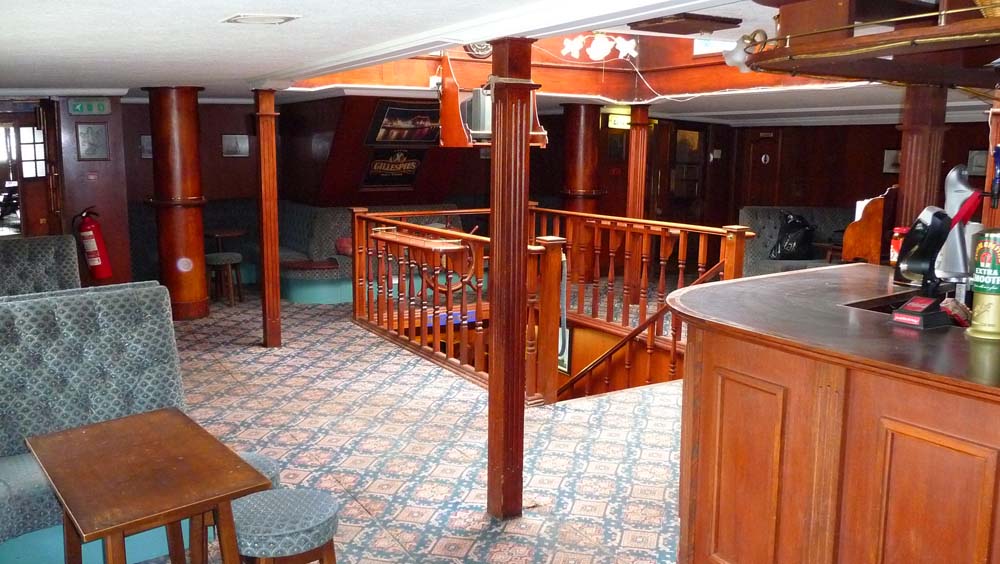

Above, some view from the main deck forward bar. The first view is looking aft, down the starboard side. Again it's hard to convey the size if this space which is filled somewhat by having the bar bang in the middle! The next photo is looking aft from further back on the starboard side and I guess the stairs leading down to the lower forward bar as described above are roughly in the same position as the crew accomodation stairs on Waverley.
I also took a fair few photos of things like the bilges for the purposes of a technical record but they are, to be honest, a bit boring for inclusion here! In any event, matters such as the material condition ohe shell plating are best left to be determined by the surveyor. There are cement repairs in the bilges as a means of addressing "pinholing". They vary from about 1/2 thick screeding, up to about 2-3" thick rather than the image most of us might have of a cement Box Repair of wooden shuttering surrounding about a foot deep block of cement. However I must repeat these visual observations are largely worthless and will be much better informed by the surveyor's report.
Stuart Mears

Sunday, 7 September 2008
A & J Inglis - Paddle Steamer Specialists
Scotland's last two paddle steamers, WAVERLEY and MAID OF THE LOCH, share a common heritage in that they were both built by the firm of A & J Inglis Ltd at their Pointhouse shipyard on the River Kelvin near to its confluence with the River Clyde in Glasgow. The firm built about 500 ships in the 101 years that they were business at Pointhouse Shipyard. A significant proportion of the 500 ships built at Pointhouse were paddle steamers. It is thought that at least 6 Inglis-built paddle steamers are still in existence in 2008. These include the former Humber passenger and car ferry LINCOLN CASTLE at Goole and the paddle train ferries EXEQUIEL RAMOS MEJIA (http://www.histarmar.com.ar/BuquesMercantes/Ferrobarcos/Ferrobarcos-EzRamosMejia.htm) and ROQUE SAENZ PENA (http://www.histarmar.com.ar/BuquesMercantes/Ferrobarcos/Ferrobarcos-RSaenzPenia.htm) in Argentina. Apart from WAVERLEY none of the surviving Inglis paddlers are operational.
In fact Inglis supplied a significant number of paddlers for the Argentine coastal and river fleets including some of the largest paddle steamers of their type ever built. One such vessel was the paddle steamer VIENA seen below (in a Robertson of Gourock picture) on the Clyde before departing for South America

VIENA was one of several large paddle steamers built on the Clyde for service in Argentina. principally from Buenos Aires. Most of them were built by Denny of Dumbarton or Inglis at Pointhouse.
The VIENA was an Inglis product and was launched into the River Kelvin on 8th June 1906.
She was based on the Paddle Steamer PARIS that Inglis had built ten years earlier for Mensajeries Fluviales del Plata (see http://www.clydesite.co.uk/clydebuilt/viewship.asp?id=1911). However, VIENA was built for Nicolas Mihanovich's Argentine Navigation Company. Some sources state that Mihanovich's son Pedro was aboard the vessel when she ran trials in the Gareloch on 17 October 1906. It is stated that she attained 16.5 knots. She seems a bit big to have run trials on the Gareloch measured mile - the picture below looks to be off Gourock.
VIENA was about 330 feet long with a beam of about 40 feet. Her gross tonnage was 2376 and she had accommodation for 340 First Class passengers and 120 in Second Class. The vessel was powered by a triple expansion steam engine built in Inglis' own engine works.
A few years after building VIENA, Inglis used the same basic design when they supplied the two large paddlers CABO SANTA MARIA and CABO CORRIENTES for Hamburg Sud Amerika Damfschiffarts in 1913. After WWI they were taken over by the Argentine Navigation Co and became GENERAL ARTIGAS and GENERAL ALVEAR respectively. VIENA was renamed WASHINGTON in 1915 (picture of VIENA as WASHINGTON).
Other large paddle steamers supplied by Inglis to the Argentine fleets about that time included the LAMBERE, BRUSELAS (http://www.clydesite.co.uk/clydebuilt/viewship.asp?id=1965) and her sister BERNA.
VIENA as WASHINGTON passed through various ownerships but remained in service until 1960. After several years of lying derelict at Rocha, Buenos Aires she sank in the basin on 3rd June 1967. The wreck was raised and scrapped by Satecna S. A. in 1981
About the same time that Inglis was supplying the paddlers to South America they also built the 1400 ton paddle steamer WEEROONA (below) for the Huddart Parker company's established excursion routes from Melbourne Australia. WEEROONA served with the US Navy during WWII and was owned subsequently by the Australian Government until scrapped in 1951.
Stuart Cameron

In fact Inglis supplied a significant number of paddlers for the Argentine coastal and river fleets including some of the largest paddle steamers of their type ever built. One such vessel was the paddle steamer VIENA seen below (in a Robertson of Gourock picture) on the Clyde before departing for South America

VIENA was one of several large paddle steamers built on the Clyde for service in Argentina. principally from Buenos Aires. Most of them were built by Denny of Dumbarton or Inglis at Pointhouse.
The VIENA was an Inglis product and was launched into the River Kelvin on 8th June 1906.
She was based on the Paddle Steamer PARIS that Inglis had built ten years earlier for Mensajeries Fluviales del Plata (see http://www.clydesite.co.uk/clydebuilt/viewship.asp?id=1911). However, VIENA was built for Nicolas Mihanovich's Argentine Navigation Company. Some sources state that Mihanovich's son Pedro was aboard the vessel when she ran trials in the Gareloch on 17 October 1906. It is stated that she attained 16.5 knots. She seems a bit big to have run trials on the Gareloch measured mile - the picture below looks to be off Gourock.
VIENA was about 330 feet long with a beam of about 40 feet. Her gross tonnage was 2376 and she had accommodation for 340 First Class passengers and 120 in Second Class. The vessel was powered by a triple expansion steam engine built in Inglis' own engine works.
A few years after building VIENA, Inglis used the same basic design when they supplied the two large paddlers CABO SANTA MARIA and CABO CORRIENTES for Hamburg Sud Amerika Damfschiffarts in 1913. After WWI they were taken over by the Argentine Navigation Co and became GENERAL ARTIGAS and GENERAL ALVEAR respectively. VIENA was renamed WASHINGTON in 1915 (picture of VIENA as WASHINGTON).
Other large paddle steamers supplied by Inglis to the Argentine fleets about that time included the LAMBERE, BRUSELAS (http://www.clydesite.co.uk/clydebuilt/viewship.asp?id=1965) and her sister BERNA.
VIENA as WASHINGTON passed through various ownerships but remained in service until 1960. After several years of lying derelict at Rocha, Buenos Aires she sank in the basin on 3rd June 1967. The wreck was raised and scrapped by Satecna S. A. in 1981
About the same time that Inglis was supplying the paddlers to South America they also built the 1400 ton paddle steamer WEEROONA (below) for the Huddart Parker company's established excursion routes from Melbourne Australia. WEEROONA served with the US Navy during WWII and was owned subsequently by the Australian Government until scrapped in 1951.
Stuart Cameron

Subscribe to:
Posts (Atom)


