Showing posts with label QE2. Show all posts

Thursday, 9 September 2010

Launch and Career of a Clydebuilt Icon to be celebrated.

The 43rd anniversary of the launch of the iconic Queen Elizabeth 2 is to be marked by events at her birthplace of Clydebank.

Waverley and QE2 met many times during the liner's long and illustrious career and I hope that members will take the time to support this event.

Clydebank ♥s the QE2! is an event organised by clyde walking tours™, in association with QE2 website and forum theqe2story.com and will consist of a 90 minute walking tour of Clydebank including the former site of the world famous shipbuilders John Brown and the area formerly occupied by the very slipway on which QE2 and many other famous liners were built and launched.

In the evening a 1 hour presentation on QE2 will be delivered by the qe2story's Rob Lightbody in the Cunard Suite, Clydebank College (College Square, Queens' Quay, G81 1BF).

For more details and to buy tickets please visit http://qe2.eventbrite.com/

Visit the internet's premier QE2 website and forum at http://www.theqe2story.com/index.html where you will find many many interesting facts, discussions and features on the world's most famous ocean liner - including Q&A sessions with two of the QE2's former masters!!


QE2 on the Clyde for the final time Oct 2008 © G Stewart

Monday, 27 April 2009

The Year That Was....Chairman's Blog No 8


I know this is cheating a bit, but I had to put together the traditional Chairman’s Report for the Scottish Branch AGM and thought it might be an idea to include as a blog. It’s simply a good time of the year to have a wee summing up of the last year that we have shared as well as looking to the future.

Paddle Steamer Preservation Society, Scottish Branch
Chairman’s Report to the Annual General Meeting
17th April 2009

I would like to briefly cover the activities of the Branch over the last year. Our activities have been well documented in Paddle Wheels and the accompanying newsletter, thanks to our Secretary Gordon Wilson. This leaves me gratefully in the position of simply covering a few of the milestones over the last 12 months.

Although it is a much abused expression, I do find it hard to believe that 12 months have already passed since I shook hands with Gavin Johnston at last year’s AGM to take on the role of Branch Chairman.

Work Parties

It is a source of continuing pleasure to see our contribution to Waverley’s winter overhaul flourish year on year. Gone are the days when we turned up on Saturdays to sweep up after the Monday to Friday gang and, if we were lucky, do a bit of painting. For several years now we have provided significant contributions to maintaining and improving the fabric of the ship and to assist in maintenance activities. We have enthusiastic painters, varnishers, electrical and mechanical engineers, and joiners who, will in fact turn their hand to just about anything. Make no mistake about it, through such activities, The Scottish Branch provide very real savings to the Waverley’s winter overhaul costs. At Balloch too, the fight goes on, possibly even more dependant of voluntary efforts by many individuals who are PSPS members. We are in a truly unique position in our Society in that we have not just one but, two Paddle Steamers to help with. Of course, for some work on Waverley is not confined simply to the off season, and Joe’s running of the souvenir shop and the staffing of it by Deryk, Ian and many others certainly has a significant “fiscal impact”.

Excursions

2008’s midsummer cruise might more accurately have been billed as the “Nearly Autumn Cruise” by the time it had been rescheduled, twice, due to Waverley’s well documented wheel repairs. That the cruise on a chilly 11 July right in the middle of the Greenock Fair Holiday still managed to turn a small profit is due in no small part to the evangelical drumming up of ticket sales by Scottish Branch members, and also due to the remarkable efforts yet again of organiser Peter Reid, and also to Margaret Skee for taking up the reigns when Peter was off on holiday. Thank you both.

On Saturday 27th of December, 88 of us set sail on the MV Cruiser on a sunny clear and crisp day for our Christmas Cruise, complete with morning coffee and Christmas cake, buffet lunch, and for the first time, two calls at Blairmore. The first call being for the now traditional mulled wine and mince pies (thanks again Agnes), and the second to drop off our Blairmore hosts who came along for the Loch Goil cruise this year. Our thanks go to Deryk for again organising such an enjoyable Christmas cruise.

I’m not sure if this bit comes under excursions as such but it is worth, mentioning our hospitality day on Waverley in August. This year, PSPS members had the opportunity to congregate in the lower bar set aside for our use for part of the day for a short talk by David Rodger followed by the now traditional Bridge and Engine Room visits. It is not overstating things to say that the success of our Hospitality day, (the lower bar was again full to standing room only) is looked on with envious eyes by our fellow enthusiasts from all the other society branches.

Exhibitions

The other Branches of our Society also look with envious eyes on our exhibitions activities. In fact, in Gavin Stewart the Scottish Branch is the only branch that has an exhibitions manager. In the last 12 month Gavin, with considerable assistance from Shelagh, has continued to be a driving force behind our representation at:


  • The Glasgow River Festival

  • Greenock Model Rail

  • Rails and Sails at the Transport Museum

  • Model Rail Exhibition at the SECC

As well as making a modest financial profit where PSPS, Maid of the Loch and Waverley souvenirs have been sold, other benefits, although harder to quantify are nevertheless very real and significant. The simple “spreading the word” regards the PSPS, Waverley and MOL including timetables where appropriate undoubtedly generates….trade, for want of a better word. Additionally this year, WavEx took advantage of our presence at the Rails and Sails exhibition to conduct some market research. In addition to Gavin’s guiding hand as exhibition manager, the list of willing volunteers from the membership who staff the exhibitions and carry out the exhibition set up, strip down and transport to and from storage is too long to go into here but I would like to record my thanks to you all. Perhaps some “I survived Model Rail 2009” polo shirts would be warranted!
Although not an exhibition as such, we have also spreading the word in Cyberspace though our blogsite http://www.pspsscotland.com/ which, Gavin Stewart, who set the whole ting up, tells me, is visited some 600-800 times a week even during the off season.

Meetings

Our program of winter meetings again covered a varied and entertaining mix of subjects.

It would be immodest of me to comment here on the Chairman’s address on the 17th of October other than to say that I decided to attend long after most of you did!

This year was our turn to host the National AGM, and this time round it was held on Maid of the Loch. Again the Scottish Branch set the benchmark for providing entertainments for the day in addition to the actual business of the AGM, with visits to the winch-house which was “in-steam” especially for the occasion, lunch which was enjoyed by some 82 members and a short presentation by the Scottish branch after the AGM itself. MOL looked particularly impressive that day, with new festoon lights supplied by Shelagh and Gavin, rigged from the maid’s masts….funded by the Society. It is also worth mentioning that thanks to the …….gentle persuasion of certain Branch committee members, Friends of Maid of the Loch also has some new members……….. Thanks Sheels!

As the winter months progressed we were treated to:


  • David Rodger’s presentation on his time with Hebridean Princess and a detailed account of her life since being converted from a “lowly” CalMac Ferry.

  • Brian Searle’s presentation on the history of Royal yachts as well as some first hand tales of his time serving aboard Britannia.

  • Guthrie Hutton’s talk on the truly remarkable regeneration of the Forth and Clyde canal.

  • Gordon Wilson’s history of the QE2 with slides contributed by several members. Who can forget the shots of her seemingly calling at some Scandinavian pier about the same size as Tighnabruiach.

  • It was particularly pleasing to see our meeting room at St Stephen’s seemingly repeatedly fuller than for some years.

Fund Raising and Financing

For 2008 we again had the kind offer from Olsen Cruise Lines to repeat their donation of the Prize of a two week cruise for two. Sales of tickets in Scottish Waters again lead the way despite the disruptions of wheel repairs and poor weather. Thanks are again due to Derek Brown for his truly sterling efforts, accompanied this year on more occasions than ever before by other branch members, whether around the deck, or in a new approach to selling them, from a table outside the purser’s office. Thank you one and all.

A huge vote of thanks must go to Committee Member Charles McCrossan for his part in the organisation of a new venture to raise funds for the Waverley. On 28th November a special concert was held at St Andrew's in the Square.
With such artists as Duncan McCrone, The cast, and JJ Gilmour of the Silencers accompanied by Graeme Duffin of Wet Wet Wet fame, all those who attended were treated to a fine evening’s entertainment.

What’s the easiest way to raise funds for Waverley? Go for a sail and take as many fiends and family as you can! This year more than ever please do all you can.

Council of Management

With some reshuffling of the COM with Alec Lewis to becoming the WSN representative, our very own Gavin Stewart filled the resultant vacancy effective from this year’s National AGM. It is good to representation from north of the Border further strengthened in this way. It would be fair to say that the dominate topic at C.O.M. meetings over the winter has been the provision of financial aid to Waverley following recent financial hardship culminating in the problems of the 2008 season. As you will have doubtless read in Paddle Wheels this has resulted in a mixture of loans and grants to the tune of over £500,000 from Society Funds. The diminution of our funds to such a severe degree has necessitated a levy on all the branch funds.
Changes to Committee membership

I would like to mention and record my appreciation of our two departing committee members. Whose contributions to the Committee will be sorely missed.

Michael Hughan I have known since the early 90’s when we became involved with the initial work on Maid of the Loch. In those very early days, the ship was in such a poor state that doing pretty much anything could not help but improve things and as our momentum grew week on week it was just as well Michael was on hand to perhaps inject some sanity into our increasingly “bull in a china shop” preservation activities! Personally I thought he took it very well when my interfering with mooring ropes and imaginative use of a chain block resulted in MOL shooting astern at about six knots into the loch one afternoon! And so over the years Michael has been quietly going about the business of being part of MOL’s restoration campaign, however his contribution cannot be underestimated. His reports to the Branch meeting, despite the many challenges that have come MOLs way over the years have always managed to maintain a sense of quiet, unwavering optimism.

From my very earliest days on Waverley, now approaching 30 years ago, Stuart Cameron has always been a part of Waverley. It was when I joined the Scottish branch however that I found just how much Stuart has been doing for our organisation. When the rest of us have been giving everyone the benefit of our opinion it is often Stuart who gets things back on track by distilling all that has gone before and then presenting us with facts rather than opinions. This has proved to be an especially valuable skill in recent times when things have been particularly intense regards Waverley, both at branch and national level.

Gentlemen, on behalf of the committee, and indeed the Society, thank you for all you have done.

Looking Ahead

This year marks the 50th Anniversary of the founding of the Paddle Steamer Preservation Society and 40 years since the inception of the Scottish Branch. I seem to remember reading in an old copy of Paddle Wheels that at one point it was considered that a Scottish Branch would never be necessary as we had so many Paddle Steamers! It is surely ironic then that the Scottish Branch that has had perhaps the most remarkable history of all the Branches. We will be celebrating our anniversary this autumn at Balloch and details of this will come out in the near future.

However, we can be under no illusions that our forthcoming year, as well as being cause for celebration, will undoubtedly be one of our most challenging to date. Make no doubt about it, in the current economic climate and given the present financial trials and tribulations of the Waverley Companies, the future of our ships is not assured. Our December talk was about the Hebridean Princess. After many years, that relatively small ship operation went into receivership only two weeks ago. That must surely be a sobering thought for all of us. As I noted earlier, the money set aside by the PSPS for the rainy day has to all intents gone and if there is a requirement for similar financial aid from PSPS at the end of this season, then I believe it is highly unlikely that the PSPS coffers will have been sufficiently replenished in the space approximately six months to meet such a need.

There is but one option ladies and gentlemen, and it is a simple although difficult solution. As never before we have to do all we can to generate revenue for Waverley in order that there is no need to come to the PSPS for financial aid. We must also do all we can to replenish PSPS resources such that if the worst happens this season, then PSPS will be in the best possible position to render whatever financial aid that it can.

It is a daunting task for sure but there is one thing of which I am absolutely certain, if any Branch can rise to the challenge, it is surely the Scottish Branch. Perhaps the most glaring thing I have come to realise on writing this report is that the Scottish Branch has a knack, through shear hard work and bloody-mindedness to punch well above its weight when it comes to:


  • Hands on preservation work.

  • Paddle Steamer evangelism through our exhibition work, hospitality days and blogsite.
    Direct fund raising though prize draw ticket sails or by new and ground breaking activities such as the fund raising concert.

  • Running successful Branch excursions.

Our Branch can and I’m sure will lead the way in our Society over the coming year, but only with your help.


Thank you.

Stuart Mears - Chairman, Scottish Branch

Monday, 6 October 2008

Balmoral Salutes a Retiring Legend

(Clicking on most of the new pictures below will open a larger high resolution view)

On Sunday 5th October the veteran Waverley Excursions motor ship Balmoral played a significant part in the final visit of one of the greatest ships that the world has ever known to the river of her birth . The celebrity was, of course, RMS Queen Elizabeth 2 the last of the great Clydebuilt passenger liners. The QE2 was built at the former John Brown shipyard in Clydebank and was to be the last of many fine passenger liners built on the river. In fact, the majority of the ships built for the famous Cunard Line were built on the Clyde (122 in total) and, when the QE2 is handed over to her new owners in Dubai in December 2008, it will be the first time in its near 170-year history that the Cunard fleet has not had at least one Clydebuilt ship in its number.

The first four Cunard liners were paddle steamers designed according to the advice of the renowned Clyde engineer and shipbuilder Robert Napier. The first of the four was the PS Britannia. At the time of her construction in 1839 Napier had yet to establish his shipyard at Govan near Glasgow, so the hull of Britannia an her sisters where built by several shipyards on the lower Clyde and towed up river to Napier’s Dock to have all of their machinery installed. Napier's Dock was at the eastern end of what is now Lancefield Quay, now Waverley Steam Navigation's office and workshop. His marine engine building works was in the adjacent Hydepark Street.


The first Cunard paddler Britannia
(Cunard Archives)

Although the Cunard Line (founded by Canadian Samuel Cunard) was long associated with the port of Liverpool, its headquarters, a lot of the capital raised to finance the Company and its early fleet of vessels was raised on Clydeside, principally by the established shipowner George Burns. The partnership regaled under the impressive title of the ‘ Glasgow Propriety in the British & North American Royal Mail Steam Packet Company’. Details of the Burns family's influential position in the development of steam navigation can be found here. In fact, the Company did not change its name to the Cunard Steamship Company until after the death of its founder in the 1880s. Again, while most of the Line’s ships, prior to the QE2, were registered in the port of Liverpool, the early fleet of ships were registered in Glasgow. After Napier established his new shipyard in the 1850s one of the first ships that he built there was the huge paddle steamer Persia for Cunard. She was the largest merchant ship in the World at the time of her construction.


PS Persia under construction at Robert Napier's Clyde shipyard
(source unknown)

The last ocean-going paddle steamer built by Napier for Cunard was the PS Scotia, launched at Govan on the 25th June 1861.


Model of PS Scotia, Cunard's largest and last ocean going paddle steamer
(Model at the Science Musuem, South Kensington, London)

As the Cunard ships became bigger the principal builder became the Fairfield Shipbuilding & Engineering Company, set up by the brilliant shipbuilder and engineer John Elder, a pupil of Napier. John Elder’s father David Elder was Napier’s highly regarded foreman for many years. The huge screw steamers Campania and Lucania represented the peak of Fairfield’s contribution to Cunard.

RMS Campania, Cunard's Record Breaker
(Model at the Science Museum, South Kensington, London)

As the 19th Century drew to a close, and Cunard’s liners became so large that the main production of liners for Cunard moved yet further down the Clyde to Clydebank where the shipbuilders J & G Thomson had established a sizable state-of-the art shipyard directly opposite the location where the River Cart flows into the Clyde. That location was to become more important as the 20th Century progressed.

Early in the 20th Century the Cunard Line, by then under the chairmanship of Baron Inverclyde of Wemyss Bay, was facing a substantial threat from large American concerns,. Lord Inverclyde negotiated assistance from the British Government for the construction of two huge new liners to fend off the American challenge. The sister ships were Mauritania (built on Tyneside) and Lusitania, which was built at Clydebank, by then under the ownership of John Brown & Co.. The relationship between Cunard and Brown’s lasted for over sixty years with many of its finest and largest ships built at Clydebank. The building of the progressively larger Cunarders was only possible at Clydebank due to the River Cart opposite , which eliminated the restriction imposed by the relatively narrow River Clyde. The decision to locate the yard there was an inspired choice by those that could not have known of the giant liners that were to be built in the next century. Consequently, world renowned Cunarders such as Aquitania, Queen Mary, Queen Elizabeth and Caronia were all created at Clydebank and the association continued with the order for Yard No 736, which became QE2 on her launch in Sept 1967. Sadly, she was to be the last prestige Cunarder to be built at Clydebank, or anywhere else on the Clyde.

Yard No 736 at Clydebank Shipyard in Sept 1967
(picture by the late William Davies)

In 2007, when the announcement came that QE2 was to retire to Dubai as a floating hotel (just as her illustrious predecessor, Queen Mary, done at Long Beach, California in 1967) there was some considerable regret that the strong link between Clydebuilt vessels and the Cunard fleet, dating back to the very founding of the Company, was finally to end. The final visit of the ship to Clydeside, on 5th October 2008, was going to be filled with an emotion that only shipbuilding and maritime communities can fully appreciate.

The Balmoral was rostered to participate in that great event. In fact, though not a Clydebuilt ship, Balmoral had a significant association with QE2 as the liner was to be the first Cunarder to be registered in the port of Southampton, which had replaced Liverpool as the Line’s main base port many years earlier. Balmoral was also registered in Southampton as she served the Isle of Wight from the city in her first life (subsequently, when she was acquired by Balmoral Excursions Ltd in 1986, her registry was switched to Bristol).

QE2 first returned to the river of her birth in 1990 when she was escorted by PS Waverley and the paddler had greeted the liner 'home' on subsequent visits in the 1990s. Balmoral had assumed the role in 2007 when she accompanied the departing Cunarder almost as far as Toward after her visit to the Clyde for the 40th anniversary of her launch in 1967. See pictures of the launch and the 40th anniversary visit here.

Due to different timings for the liner’s last ever return to Clydeside, the Balmoral was able to join a large flotilla of craft including the Royal Navy destroyer HMS Manchester that escorted the liner on her arrival. So at the early time (for a Sunday) of 0900 an almost capacity quota of passengers joined the 59-year old motor ship at Greenock’s Customhouse Quay to go and meet the liner. After a unprecedentedly poor summer (even the previous day was horrible), the 5th October 2008 dawned with an almost cloudless blue sky. It was almost like a dream that the weather could be so good and undoubtedly it added immensely to the enjoyment of the tens of thousands of people who came to see the Clyde’s last great liner for the last time.


Balmoral, dressed fore and aft for the special day at Greenock about 0900.


Queen Elizabeth 2 had served, like her predecessors, as a troopship in time of conflict (Falklands War 1982) and as a mark of that the Royal Navy honoured ‘our old friend’ by assigning the Type 42 destroyer HMS Manchester to escort the liner from the lower Firth of Clyde to the famous ‘Tail of the Bank’ anchorage off Greenock .


The magnificent QE2 arrives back on the Clyde for the last time


HMS Manchester escorted QE2 from the lower Firth of Clyde to the Tail of the Bank

After the extremely successful escort sailing Balmoral left Greenock for Glasgow to bring another near capacity crowd of passengers to view the liner at the Ocean Terminal at Greenock. As an added bonus Balmoral cruised around a number of large naval vessels that were at anchor off Greenock in preparation for extensive naval exercises off the West Coast.


Balmoral heading upriver to Glasgow


Balmoral passing QE2 on her second special sailing


Balmoral passing the Royal Navy aircraft carrier HMS Ark Royal
(with the classic motor cruiser Fenella in the foreground)


Balmoral ‘threading the needle ‘ between HMS Ark Royal and the destroyer HMS Manchester.
Waverley's original base, the derelect remains of Craigendoran pier, can be seen in the Background

Within the next decade both of these vessels may be replaced by new tonnage under construction on the Clyde and elsewhere, Manchester by one of the six Type 45 destroyers currently under construction at Scotstoun and Govan and Ark Royal by the new aircraft carriers HMS Queen Elizabeth and HMS Prince of Wales (the largest sections of which will be constructed at Govan)


Balmoral having a brief look at the RFA Mounts Bay (built upriver at Govan) and HMS Bulwark, constructed at Barrow-in-Furness. Bulwark's landing craft were also built at Govan.

Balmoral headed back upriver to Glasgow to embark yet another near capacity crowd before setting sail to join the flotilla that escorted magnificent QE2 away from the Clyde – all in darkness so no pictures I’m afraid.


Capt Andy O'Brian, Waverley Excursions senior master takes Balmoral away from Greenock.

Balmoral’s season is over and it is no secret that it has been a most disappointing one. Therefore, it was good to see her so busy on that most unforgettable of days. Next year is her Diamond Jubilee. Let us hope it will bring her the passengers that she deserves to have.
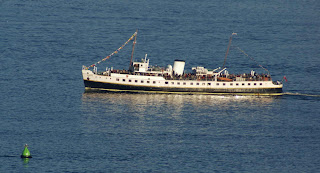
Balmoral's 2008 season ended on a high with three full load sailings in an unforgetable day


QE2 has gone from the Clyde and we know that we will never see her likes again here.
(More General pictures of the QE2 visit on alternative website - links to follow)
All pictures by Stuart Cameron except where indicated