Wednesday, 30 June 2010

Waverley at Greenock Customhouse Quay, Rothesay and Tighnabruaich - First Clyde Main Season Weekend

Waverley's first Saturday call at Greenock of the 2010 summer season
(Pictures are my own except where stated otherwise, click on picture for full screen view).

Like parts of Waverley's 2100 IHP triple expansion, reciprocating steam engine, the newly repainted Customhouse Quay clock tower was cast in the nearby Rankin & Blackmore's Eagle Foundry in Baker Street, Greenock (click on the image for a bigger view).
Daniel Rankin and Edward Blackmore had started their foundry business in the 1860s. Due to Rankin's pioneering training methods, for his staff, the Eagle Foundry became known locally as 'the Academy'  (not, of course, to be confused with the renowned Greenock Academy!). In the 1920s Rankin & Blackmore was taken over by the shipbuilding dynasty, Lithgow's of Port Glasgow, then the largest privately owned shipbuilding group in the world, and remained part of that group until the closure of the Eagle Foundry in 1964.

Pictures from MV Cruiser (on private charter)

Below, two more shots from the first Saturday of the paddler's 2010 summer season, these being courtesy of Tom Dunlop. In the first she has canted round the dolphin at the old Berth 1 end of Rothesay pier and is just starting to go astern; this being her normal departure from the pier following the significant rearrangements of the shore side in recent years. Three blasts on the steam whistle (to alert unsuspecting 'wafies' who probably don't know what the signal means anyway!).


and so .......


to Tighnabruaich for the first visit of 2010.  First stop: Suzies for some and Tighnabruaich Hotel for others.

Below, on to the Sunday of the first Clyde main season weekend, with some views from the paddler rather than of her. First up, Waverley finds an unusual visitor at the Braehead pontoon - Clyde Marine's motor vessel Rover. Rover had been deputising for the larger mv Cruiser on her new 5-days per week schedule from Glasgow Broomielaw to the Titan Crane at Clydebank (Cruiser having been on a private charter from Greenock on the Saturday).

In fact, at this berth Rover is not far from her birthplace - she was constructed for Clyde Marine Motoring Co. of Greenock in 1964 by the boatbuilder Hugh McLean & Co at their Clyde Boat Yard in Renfrew. The yard was located just upstream of the Clyde Navigation Trusts former workshops and patent slip on the riverside adjacent to the east side of the legendary Pudzeoch (basin). McLean was a prodigous builder of quality small craft, not least being lifeboats for the many prestigious liners built on the river during the halcyon days of Clyde Shipbuilding including those for Cunard's Queen Mary. MacLean's main rivals for this work on Clydeside were Mechans Ltd , which operated from the Scotstoun Ironworks at Balmoral Street on the north side of the river (almost directly opposite the location of this picture). Some estimates put MacLean's output at over 5000 new boats. Rover's Kelvin diesels were supplied by another Glasgow firm Bergius Kelvin whose manufacturing works were in Dobbie's Loan, north of George Square. The firm produced thousands of small diesel engines for small craft, the fishing industry being a major customer. The Dobbie's Loan works are long since closed. Kelvin diesels are now serviced by British Polar Engines Ltd of Helen Street in Govan but no new engines have been produced for many years.


In the picture above, Rover is berthed alongside the preserved, former steam, coaster Kyles, which is now thought to be the oldest Clydebuilt vessel still afloat. In fact Kyles was built on the White Cart River in Paisley. She was Yard No 11 when built by John Fullerton & Co as a cargo coaster for Stuart Manford of Glasgow in 1872. Over the following 112 years she had no less tham 16 different owners on Tyneside, Humberside, the Thames, South Wales and elsewhere on the Bristol Channel. At times in her long and adventurous career she was converted into a sand dredger, salvage vessel and sludge carrier. Her original steam engine, built by William King & Co of Glasgow (a well known builder of marine steam engines in the 19th century), was replaced, in 1953, by  a 120 BHP, 4 cylinder diesel engine built by Appingedammer Brons Motoren but that engine dates from 1929 so it had seen significant service before it went into the Kyles. Kyles has been owned by the Scottish Maritime Museum since 1984 (see also http://www.clydesite.co.uk/clydebuilt/viewgal.asp?id=4) and based at their 'Clyde-built' out-station at the Braehead shopping centre  in recent years.

Also viewed from Waverley last weekend were two new Coastguard partol vessels being built at BAE Systems Scotstoun Shipyard (formerly Yarrows) for the Government of Trinidad & Tobago. The first vessel, the TTS Scarborough, was launched on 19th November 2009 after which she entered the covered drydock at Scotstoun, the first vessel to go into that Drydock in many years. It was the first drydock to be built at the Elderslie Dockyard when the shipbuilder and repairer John Shearer & Son was forced to vacate their Kelvinhaugh Slipdock in 1907 to make way for the new wharfage that became known as Yorkhill Quay (where the Tall Shp Glenlee is currently berthed, though not for much longer). Scarborough  is now alongside the original Yarrow fitting out berth created when the firm moved to the Clyde from Poplar on the Thames in 1906.


TTS Scarborough (CG51)  alongside at Scotstoun (viewed from Waverley)

Scarborough's sister ship (seen below on the easternmost of the two covered building berths at Scotstoun) is due to be launched in to the Clyde in the early hours (circa 04:00) of 16th July and, subsequently, she will be named TTS San Fernando. These covered building berths were created by Yarrows after they acquired the adjacent yard of the Blythswood Shipbuilding Company, which had produced its last ship, the Northern Lighthouse Commissioners tender Fingal, in 1964.


Below, the view aft from Waverley slightly further downsstream - the future HMS Defender, fifth of the six new Royal Navy Type 45 destroyers,  in the No 3  drydock at Elderslie Dockyard (on the left side of the picture) with  HMS Dragon in No 2 drydock (on the right side of the covered No 1 dock) and HMS Diamond lying alongsde Elderslie Wall. TTS Scarborough can be seen in the dstance at the old Yarrow ftting out quay.  Diamond has recently completed her sea trials and will soon be handed over to the Royal Navy to join the first two Type 45s, Daring and Dauntless, in the fleet. As can be seen in this view, Defender in Dry Dock No 3 is sitting much higher than Dragon in No 2. This is because the No 3 dock has been specially modified to act as an enclosed, non-tidal wet dock  in which the large gas turbine engines can be tested to a much greater degree, and free of tidal restrictions, before the vessels put to sea for the first time. The Type 45 destroyers are the first RN ships ever to adopt turbo-electric transmission, thus eliminating gearboxes, for long one of the least reliable parts of naval machinery installations


The No 3 drydock at Elderslie was built in the 1960s when the firm of Barclay Curle, which had recently closed its famous Clydeholm shipyard further upriver at Whiteinch, expanded its shiprepairing business at the Dockyard. One of the first vessels to enter No 3 dock was the brand new passenger liner Kungsholm which was being built at the John Brown shipyard at Clydebank for the Swedish America line. Kungsholm was the penultimate ocean liner to  be built at Clydebank, after her came only the famous Queen Elizabeth 2 (QE2). Although both of these prestige liners were stunning ships in the 1960s and were built to a level of quality that saw them far surpass their original design lives, they proved not to be good contracts for their builders. Brown's lost heavily on both contracts and were driven to the edge of bankruptcy from which they never really recovered.


A press cutting of the beautiful passenger liner Kungsholm leaving her builders yard for sea trials

As is well known QE2 retired to Dubai in 2008 but she is sadly redundant there, a victim so far, of world recession. Kungsholm is still in service, currently named Mona Lisa but her long career will come to an end later this year as she will no longer be able to comply economically with the latest SOLAS (Safety of Life at Sea) regulations. Soon afterwards she is likely to follow many of her predessessors and contemporaries in a full speed, suicidal final run onto the beaches at Alang in India were she will quickly be ripped apart by the oxy-acetylene burner gangs. When Mona Lisa ex Kungsholm has gone, for the first time in well over 150 years there will be no Clyde-built passenger liner sailing anywhere on the world's oceans - indeed, the end of an era.


The beautiful Kungsholm
now (as Mona Lisa) the last surviving operational Clyde-built passenger liner in the world
but not for much longer
(Splendid picture of her by Bob Scott)

Thursday, 24 June 2010

Lake of Lucerne paddle steamer introductions

If you have not visited the website of SGV  (Schiffartgeselschafft des Vierwaldstattersee or the Lake of Lucerne Navigation Company) for a while you might find some interest in a relatively new addition to their website - movies introducing the services and ships operated by the company. Of particular interest to paddle steamer enthusiasts will be the individual films introducing the paddle steamers Stadt Luzern, Uri, Schiller and Gallia, all four vessels being introduced by one of the SGV captains. The film on DS (Dampfschiff) Uri has some excellent views of the vessel's stunning First Class (Dining) Saloon, famed for its elaborately decorated wood panelling and its unique deckhead, adorned with delicately painted Alpine flowers. The Uri is introduced by Captain Beat Kallenbach who has been closely associated with Switzerland's oldest operational paddle steamer for a number of years and many Scottish Branch members will remember meeting Capt Kallenbach during his visit to Waverley during her Diamond Jubilee celebrations on the Clyde in 2007 when Waverley flew the flag of Uri (the paddler and he Swiss Canton after which she is named) to mark Capt Kallenbach's visit and recognising that he flew Waverley's name pennant and the houseflag of the Waverley Steam Navigation Company on the 'jackstaff' and mainmast of DS Uri during a visit of several of the Scottish paddler's crew to Lucerne some years earlier. This is the link to the SGV movies gallery - once you get there you can select the movies indiviually:

http://www.lakelucerne.ch/en/company/movie-gallery.html

The flagship of the SGV steamer fleet is DS Stadt Luzern, the largest and newest of the five vintage steamers on the lake. Senior master Captain Kuno Stein, for many years associated with DS Schiller, introduces Stadt Luzern as her master. Capt Stein is also remenbered by many PSPS members for his visits to Waverley and Kingswear Castle on the Clyde and the Western Isles and on the Thames and Medway.

Captain Kuno Stein on paddle steamer Schiller
Captain Stein enjoying a sail on paddle steamer Waverley from Portree, Isle of Skye, Scotland.
A close encounter with paddle steamer Stadt Luzern near Treib on Lake of Lucerne
Paddle steamer Stadt Luzern passing under the spectacular rock structures where the scars of geological turmoil that happened much earlier in plant Earth's life are laid bare for all to see. The incredible Axenstrasse roadway between Brunnen and Fluelen was blasted and cut through the mountains in recent times. Motor ship Rigi can be seen ahead of the paddler, heading to Fluelen from Tellesplatte. Part of the Alpinr resort of Seelisburg can be seen in the mountains above MS Rigi .
Paddle Steamer Uri on the Vierwaldstattersee
Captain Beat Kallenbach on Uri on Lake of Lucerne
Paddle Steamer Schiller sailing between Rutli and Bauen in 2007
Paddle Steamer Schiller's builders plate
Paddle Steamer Gallia sailing between Vitznau and Beckenreid in 2008
All pictures are my own more at :


 and


Wednesday, 9 June 2010

Ship Shape and Bristol (Channel) Fashion!

No sooner have Waverley's Western Isles trips finished but our little paddler is on it's way somewhere else! Somewhere else at the moment is the Bristol Channel where she will spend a couple of weeks entertaining her friends, supporters and the public in general undertaking varied sailings. Her timetable for this area can be found here .

Waverley left the Clyde on Wednesday 2nd June arriving at Swansea in good time to take her first sailing from there to Lundy Island on Saturday 5th. This sailing took her from Swansea to Porthcawl, Ilfracombe, Lundy and back. It was at Portcawl on the outward leg that Chris Jones caught her in good weather loading a healthy number of passengers for the day's sailing. She left for Ilfracombe with 700+ aboard.

Chris has kindly given the branch permission to post photos taken by him at Portcawl.


Waverley backs away from Portcawl - next stop Ilfracombe.
Thanks to Chris for the pics!!

Gavin Stewart

Monday, 7 June 2010

Waverley in the Western Isles 2010

I saw Waverley off from Glasgow on the Friday morning and then joined her at Oban for the Sunday evening run up to Fort William and the sailing to Tiree on the Monday.  Two days of glorious weather, great passenger numbers, good company and great sailing.


Its always good to see an orderly queue wending its way towards the gangway
At 06:50 in the morning it looks even better


After all the winter work, drydock overhaul, trials and careful planning by all involved, 
the official start of the 2010 season at 07:00 on Friday 28th May was delayed............
because the Sandwich man was late!!
Finally on the move at the start of her 2010 season.
Canting into Prince's dock entrance


Off she goes down the Clyde - or so we thought!


 A good 250/300 metres into her stride and still she won't let go of her winter berth!
The cant rope got stuck on the wooden rubbing piles on the face of the quay 
and can be seen stretching out behind Waverley. 

 Waverley finally detached from the rope and heading downriver
with the new Glasgow Transport Museum taking shape in the background.

This shot gives some impression of the potential future difficulties for Waverley,
when the Tall Ship Glenlee gets moved to her Transport Museum berth, 
where she will be lying in the river above, but to the left of,
where Waverley's port paddle box is in this photo.


Waverley arriving into a very sunny Oban bay on Sunday evening 
with the small cruise ship Quest heading out of the bay, having just
vacated the North Pier berth (and holding up Waverley with her delayed departure)


 Arriving into North pier Oban

Seeing the crowds on board I was a bit worried about there being something left to eat for my tea 
However not only was there plenty of food, but the highlight of my weekend was getting 
one of the really excellent  "Sunday lunches" for my tea - good food and travel must go together!
Well done to Craig and his team! 


Monday morning dawned bright and sunny with the promise of a great day.
 Waverley arriving into Oban bay after her run down from Fort William


Heading across the bay to North pier


The repainted funnels looking resplendent in the sunshine alongside Tiree pier


Waverley going astern from Tiree pier on her short cruise


Heading out from Tiree


Paddles biting in as she starts to move ahead


Returning to Tiree after her short cruise

Waverley alongside at Tiree with the David MacBrayne house flag 
(kindly supplied by her supporters from Arran) shown off to good effect above the bridge.


For many, the first weekend on Waverley is just another (or a first) day trip away somewhere.


However, for a significant number of her passengers over the whole weekend it is a chance to meet up again
with good friends and acquaintances that you said cheerio to on the last sailing day, the previous October,
or maybe even haven’t seen since the last West Highland weekend.


There is plenty of time to chat, laugh, eat and drink in good company while catching up 
on the events of the past six months and reminiscing about days and years gone bye. 

However I did think it was a bit much when I was sitting having my breakfast 
in the B&B on the Monday morning and suddenly found myself surrounded by Arranites – 
or maybe it was the scary stories I was being told about vicious Teddy Bears that put me off my “full Scottish”!! 


A larger selection of photos of Waverley and other sights and shipping seen over the weekend can be found at 

Recent Shipping Photographs


Charles McCrossan

More Dunkirk 70th Anniversary Photos

Following on from the previous post - WSN Secretary and Scottish Branch Committee member Deryk Docherty has given permission for a couple of his photos of the ceremony - taken from the port side paddle box.


Thanks again to Deryk for permission to post these images.

Gavin Stewart

Tuesday, 1 June 2010

Dunkirk 70th Anniversary - Waverley Remembers Her Illustrious Predecessor


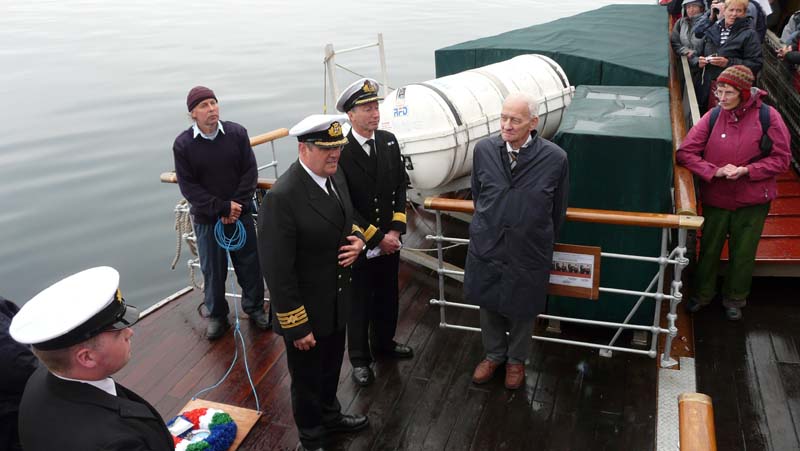
Shortly after departing from the pier at Armadale on the Isle of Skye on Saturday 29th of May 2010, heading for Oban, paddle steamer Waverley stopped in the Sound of Sleat to commemorate the part played by her predecessor HMS Waverley during Operation Dynamo, the evacuation of Allied Forces from the beaches of Dunkirk, exactly 70 years earlier.

The North British Railway company had ordered a large and fast paddle steamer from the Clyde shipbuilders A & J Inglis of Pointhouse, Glasgow in 1898 and the new vessel had been launched into the River Kelvin on 29th May 1899. PS Waverley of 1899 played a significant role in the business of the Craigendoran based steamers over most on the next four decades. During WW1, in common with many other Clyde paddlers, she had been requisitioned into the Royal Navy to serve as a minesweeper and again, as she approached the end of her commercial career, she entered another period of naval service soon after war was declared in Sept 1939. Her role in the Dunkirk evacuation has been well documented although the number of lives lost when the ship was bombed and sunk as she headed back to England has been overestimated in some publications. Her master at the time of her loss was Capt John Cameron. Although a non-swimmer Capt Cameron survived the sinking and became the first master of the replacement Waverley when she entered service on the Clyde in June 1947. At the 40th anniversary of Dunkirk Capt Cameron, a native of southern Skye, returned to the waters off Dunkirk on the present Waverley and cast a wreath onto the sea. Capt Cameron continued his career on the Clyde steamers operated by the Caledonian Steam Packet Company until the early 1970s. He commanded many of them, prominently the Glasgow-based turbine steamer Queen Mary II for a prolonged period. Captain Cameron and his wife Jean lived in the Jordanhill district of Glasgow. For some time he was President of the West of  Scotland Branch of the Dunkirk Veterans Association. After Capt Cameron's passing a diver discovered the wreck of HMS Waverley, which is officially recognized as a war grave. Therefore, diving onto the wreck and removal of parts is not normally permitted but permission was given to bring one of the brass framed circular ports from HMS Waverley to the surface. It was presented to Mrs Jean Cameron who passed onto Glasgow Museums for preservation in perpetuity. The port was displayed on the wall of the Clyde Room at the Museum of Transport in the Kelvin Hall until its recent closure. Hopefully the port will be displayed again in the new Riverside Museum from 2011 This would be most appropriate as the Museum is being built on the site of A & J Inglis Pointhouse Shipyard where the North British Railway's third PS Waverley (of 1899) and fourth Waverley (the present ship) were both built.

The fitting commemortion of the 70th anniversary of the loss of HMS Waverley was organised by the current Senior Master of the Waverley Steam Navigation Company, Captain Andy O'Brian, in conjunction with Commodore Angus Ross RN and both gentlemen are to be congratulated for a simple yet very dignified event. 


Waverley's master, Captain Andy O'Brian (left) and  Commodore Angus Ross (Centre), representing the Royal Navy, during the commemoration of the loss of HMS Waverley, 70 years earlier.

HMS Waverley sank below the surface of the English Channel at 5.46pm (17:46) on 29th May 1940, the 41st anniversary of her launch. After Commodore Ross gave a brief summary of the events leading up to the loss of HMS Waverley; at 5.46pm on 29th May, 2010, a wreath was laid onto the surface of the calm waters of the Sound of Sleat. A single long blast from Waverley's steam whistle saluted the brave soldiers and sailors that were lost The paddler returned to Oban with her ensign dipped.


Waverley's ensign dipped, in memory off those lost during the sinking of her predecessor, as she returns to Oban.

See also

http://www.heraldscotland.com/sport/spl/aberdeen/clyde-built-heroines-of-dunkirk-1.575430

http://freespace.virgin.net/tom.lee/waverleynbimg.htm


The following British Pathe news clip show some Dunkirk Veterans returning to the beaches in 1950 aboard the London-based excursion turbine steamer 'Royal Daffodil' which was built at the William Denny & Bros Leven Shipyard in Dumbarton. (note: sometimes there is a 'commercial' at the start of the clip which lasts for about 20 seconds before the news clip starts - use the size control to go Full Screen)

DUNKIRK 1940-1950


Stuart Cameron

Thursday, 27 May 2010

Waverley in Loch Linnhe Sunday 31st May 2009

Waverley acknowledges Lord of the Glens
as the two ships pass on a tranquil Loch Linnhe


Surrounded by magnificent scenery


Heading for a very busy day at Oban

Only 3 of many thousand photos taken of Waverley during 2009,
but certainly 3 of the best!
Hopefully these photographs will encourage a few more to support Waverley,
during her weekend in Oban, 2010.

Waverley had a great weekend in the Western Isles last year, based at Oban, and Sunday 31st May provided idyllic conditions for sailing on the world’s last seagoing paddle steamer, especially the morning and evening legs in Loch Linnhe.  This wee story, and the photographs above, is intended to whet the appetite for the approaching Western Isles weekend

Robin Copland is a very affable character with a great love for Waverley, an in-depth knowledge of Malt Whiskies (and regularly checks that things are how he remembers them!) and a passion for the sport of Curling.  In his younger years he also had “a thing” for Duchesses – of the turbine variety - which he sailed on regularly during his family summer holidays in Largs.  I grew up in Largs but our paths never crossed during his visits there.  I currently live within a few hundred yards of where he grew up in Glasgow, and I now regularly shop on the site of where he often went Curling in his youth, but Robin is long gone to a big city in the east.

I got to know Robin in recent years through the Clydesite website for shipping enthusiasts, where Robin originally posted the following photos.  I think these lovely photos should be seen by a much wider audience of Waverley enthusiasts and supporters and Robin has very kindly agreed to me putting them on this blogsite. 

From conversation with Robin on the way to Oban last year, and having enjoyed his travelogue stories on Clydesite, the background to how these photos ended up being taken at all, make them all the more special and I’m sure Robin will look back over his 2009 West Highland adventure in years to come with a sense of satisfaction and achievement.  However, with due respect to Robin, who may by now be considering book offers and film rights for the full story, I’ve tried to condense some of the more pertinent points into the summary below, around that wonderful little word ....IF.

IF we had not met through Clydesite the story would never begin
IF Waverley had visited Oban on her original planned dates Robin would not have been there due to work commitments
IF Calmac’s Clansman did not have technical problems during that particular weekend when Waverley did go to Oban, there would have been no disruption to services, which impacted significantly on Robin’s plans, but added to the adventure!
IF Robin was not fortunate enough to have a brother as Manager on a certain west coast luxury cruise ship he would not have had a bed for the night alongside Craignure pier, after Waverley’s arrival at Oban, and he most certainly would not have been in the right place at the right time for the photographs.
IF Robin’s brother had not left his bicycle at the Craignure Calmac office for Robin to use, after his visit to Iona on the Saturday, he would have missed out on one of life’s great “adventures”.
IF Robin’s heart, lungs and legs had not held out, he would never have managed to cycle the 6 miles from Craignure to Fishnish in 24 mins.  Some of those who sampled Waverley’s range of malt whiskeys with him on the way to Oban may be a little more pointed in their comments but suffice is to say that Robin doesn’t look like a man who regularly achieves and maintains 15 mph on a push-bike!!
IF the last ferry from Craignure to Oban had not been cancelled on this day, he might have found the return 6 miles on the bike too big a challenge.
IF he was not the friendly and sociable character that he is, he may not have chatted with the Calmac crew on the Loch Fyne and found out that his onward transport to his floating bed alongside Oban pier had been cancelled.
IF he had not met a friendly bus driver called Alex on board the Loch Fyne – with an empty bus and boot – who just happened to be going back the long way around to Oban, Robin might still be somewhere on that road from Lochaline to Oban.
IF the Calmac timetable and ship rotas had been back to normal on the Sunday morning, he would have taken a trip to Coll on board Lord of the Isles and missed this great photographic opportunity.   
IF his brother was not working on Lord of the Glens, he would not have been sailing serenely up Loch Linnhe on board her on the Sunday morning, as Waverley steamed down from Fort William

The story continues after the photographs with calls at Corpach, travels on the West Highland Line, a drunk Irish girl on the train home to Edinburgh etc, etc but that is probably all best left for “the book” , when it comes!

Many thanks Robin, for sharing your travels, your experiences and your photographs and a very special thanks for being a great sport and letting me be selective about which of your own words I used to tell the story.

Charles McCrossan


Saturday, 22 May 2010

Waverley goes for a paddle!

With just a week to go to the start of the 2010 season, Waverley sailed downriver from Glasgow to the mouth of Loch Long on Friday 21st May. Some photos from her afternoon out are below. Hopefully the trip to and around Oban, next weekend, will get similar glorious weather, apart from the mist on the lower firth which impeded shots of her around Loch Long.

 Waverley approaches Braehead 


Heading down past BAE Scotstoun yard
(I liked the wiggly funnel reflection in this photo!)

 Off Helensburgh 1
(I assume this was setting the compass time)


 Off Helensburgh 2


Off Helensburgh 3
(Note difference in toilet window arrangements between Port and Starboard)
Off Helensburgh 4
Off Roseneath and now heading for Loch Long


After several circuits off the mouth of Loch Long in the mist,
Waverley heads for home past Kilcreggan pier

Here's hoping for great weather and a great 2010 season 
for this grand old lady, who continues to battle the odds

Charles McCrossan

Saturday, 15 May 2010

A Sad Day on the Tyne - and the Clyde

The following short video represents the end of yet another era - when the final cranes and the floating drydock from the River Tyne's last shipyard, Swan's at Wallsend, were shipped out to a new yard in India aboard the heavy lift ship Osprey. The floating drydock was shipped on the Osprey's deck with the cranes fixed to its deck.

The crane jib nearest Osprey's bow belongs to Swan Hunter's floating crane 'Titan III', once a very familiar sight along the Tyne when, like the Clyde, it was lined with shipyards, from Elswick to North Shields. Remarkably, there is also a part of Clyde shipbuilding on the departing vessel. The last crane - nearest Osprey's bridge - was originally built in early 1960s by the famous Glasgow structural engineering company Sir William Arrol & Co for the substantially modernised Clydeholm shipyard of Barclay Curle & Co at Whiteinch in Glasgow. Despite such large investments and modernisation the Clydeholm yard closed only 3-4 years later and the nearly new Arrol cranes were transferred to Swan Hunter's Neptune shipyard at Wallsend (Barclay Curle had been a subsidiary of Swan's since the 1920s). Remarkably, one of those cranes is now in its third shipyard - in India! Surely none of the Arrol workers that built it in the crane works at Nuneaton Street in the east end of Glasgow half a century ago could have predicted that it would have such a remarkable career. Undoubtedly Waverley sailed past this crane during its early years on the Clyde and again nearly 30 years later when the paddler made several visits to Tyneside in the early 1980s. I doubt that they will meet again!


Stuart Cameron

Sunday, 9 May 2010

Waverley's Birthplace Reborn

In just over a year from now the new £85m Riverside Museum that will replace the Glasgow Transport Museum and be expanded to tell the story of the city's industrial heritage will be opening its doors for the first time. The new museum is being constructed on the site of the former A & J Inglis Pointhouse shipyard where the River Kelvin flows into the River Clyde. The Inglis firm occupied the site for just over 100 years up to its closure in 1963. In that time over 500 ships were built in the Pointhouse shipyard including the British Royal Yacht Alexandria in 1907, the paddle steamer Waverley and the Loch Lomond paddle steamers, including the preserved Maid of the Loch. Inglis built a large variety of vessels including small ocean liners for the British India Steam Navigation Co, destroyers and frigates for the Royal Navy, train ferries for the Entre Rios Railway in South America and the Mihanovich paddle steamer fleet on the River Plate - to name but a few. The following picture shows a view of the shipyard offices and workshops looking north from the Clyde. The river side facade of the new museum is on virtuually the same location as was the river side frontage of Inglis yard.


A registered charity www.riversideappeal.org is raising £5m to go alongside the £74m commited to the project by the City of Glasgow Council and the Heritage Lottery Fund. The chairman of the Riverside Museum Appeal is Maryhill-born the Rt Hon Baron Smith of Kelvin (see biography below)  Another trustee is broadcaster Carole Smillie and she and Lord Smith outline the massive project on several videos most of which are now available on YouTube.


The Riverside Museum will contain over 3000 exhibits, more than double that on show at the old Museum of Transport in the Kelvin Hall, which closed last month to allow transfer of items to the new site to begin. They should include a significantly increased number of the 700+ Clydebuilt ship model collection than the 200 or so that could be exhibited in the Kelvin Hall.

Rt Hon Baron Smith of Kelvin

Robert Smith was born and raised in the Maryhill district of Glasgow. In addition to his chairmanship of the Riverside Museum Appeal he is currently Chairman of The Weir Group plc and Scottish and Southern Energy and a non-Executive Director of 3i Group plc, Standard Bank Group Limited, and Aegon UK plc. He is also Patron of the Scottish Community Foundation. In 2008, Lord Smith was appointed as Chair of the Glasgow 2014 Commonwealth Games organising company. He is also the Chancellor of the University of the West of Scotland. During a long and distinguished career Lord Smith has previously served as a Governor of the BBC, Chairman and CEO with Morgan Grenfell Private Equity, CEO of Morgan Grenfell Asset Management and was Vice Chairman of Deutsche Asset Management between 2000 and 2002. He has held various positions as director of, MFI Furniture Group plc, Stakis plc (of which he was also Chairman from 1998 to 1999), the Bank of Scotland, Tip Europe plc and Network Rail. He was Chairman of the Board of Trustees of the National Museums of Scotland from 1993 until 2002. He is also President of the British Association of Friends of Museums, a position he has held since 1995, and was a member (1988-1998) and Vice Chairman (1996-1998) of the Museums and Galleries Commission. Lord Smith and the owner of the Island of Inchmarnock in the Kyles of Bute and of the small ferry Marnock and the reduced scale replica Clyde puffer Maryhill, both of which he commissioned from the Ardmaliesh Boatyard on the island of Bute. Marnock is used to ferry supplies between Inchmarnock and Bute while Maryhill is used by Lord and Lady Smith and their two daughters for leisure purposes.


Stuart Cameron