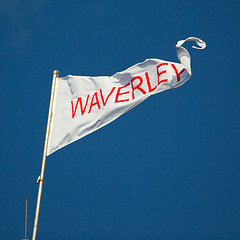
Sunday, 12 August 2012

Waverley's Sabbath Trip to Tarbert

 - a tale of Poppy Leaves and Paddle Steamers


Paddle Steamer Mary Jane at Tarbert Loch Fyne in 1856

Today, the 12th of August 2012, 200 years after the pioneer Clyde paddle steamer, the Comet, first churned up the still river waters, PS Waverley performs her one and only Sunday visit to Tarbert Loch Fyne of 2012  - it is also the Paddle Steamer Preservation Society Scottish Branch annual hospitality day and the Branch committee will be pleased to meet members, old and new, on board. the picture aboveshows an earlier call by a paddle steamer at Tarbert - the paddle steamer Mary Jane in the inner harbour, probably in 1856 (only 10-15 years after photography was invented). The Mary Jane was built by the early upper Clyde shipbuilding firm of Tod & McGregor in 1846 at their original shipyard at what later became Springfield Quay (just downstream of the Kingston Bridge on the south bank of the river). Mary Jane's original owner was Sir James Matheson, one of the two Scottish founders of the great Hong Kong based trading company Jardine Matheson (still to the fore but now based in Singapore, I think)
Sir James Nicolas Sutherland Matheson, 1st Baronet
Matheson and his partner made their vast fortune conveying much sought after commodities from China to the UK. On the outward journeys they conveyed opium sourced from the Ottoman empire, which they sold to the Chinese. Nowadays, they would be condemned as international drug dealers, opium (from the poppy fields of Afghanistan and elsewhere) being the source material of the multi-billion pound illegal global heroin trade - but in the 19th Century it was positively encouraged by the British Government as a means of addressing the country's serious balance of trade deficit with China.
After William Jardine died a bachelor in 1843, his nephews David and Andrew Jardine assisted James Matheson in running the Hong (Chinese name for a trading firm) as the Tai-Pan (the head of a Chinese trading company). However, Matheson retired as Tai-Pan soon thereafter and handed over to David Jardine, another nephew of Jardine. Matheson, who was born in the village of Shiness near Lairg in Sutherland (which, despite its name, is the second most northerly county in mainland Scotland), returned to Scotland and used some of his 'ill-gotten gains' to buy the island of Lewis in the outer Hebrides in 1844 and commissioned the paddle steamer Mary Jane, named after his wife, to provide a regular service, summer and winter, from Glasgow, round the Mull of Kintyre, up through the Hebrides and across the Minch to Stornoway, capital of Lewis. She set sail on her first voyage from Glasgow on 18th June 1846 He built Lews Castle as his country seat and spent around £0.5m (a vast sum of money then), improving roads, farming methods and housing in Lewis and was regarded as a great benefactor there. Interestingly he tried to develop industry on the island, building a chemical works to try to utilise the island's valuable indigenous minerals but this came to nothing for reasons that are not well researched. As a result of his actions during the Highland Potato Famine, Matheson was rewarded with a baronetcy in 1851. He was Member of Parliament (MP) for Ashburton from 1843 to 1852 and for Ross and Cromarty from 1852 to 1868. He died at the age of 82 in Menton, France on Hogmanay, 1878. Having no children, the baronetcy became extinct on his death.
PS Glencoe (J B MacGeorge collection)
Matheson's fleet of steamers was increased to two when in 1849 when he started to run the paddle steamer Marquis of Stafford (launched at J Reid & Son's East Yard, Port Glasgow on 29th September, 1848), which he owned jointly with the Duke of Sutherland, on a mail service between the mainland terminal of Poolewe and Stornoway. This service had commenced in the late 1700s using sailing vessels. The mails were conveyed by foot between Poolewe and Dingwall . Matheson sold the Mary Jane to the Glasgow & Loch Fyne Steam Packet Company in 1851 and this picture is likely to date from the period in which she was in their ownership. She passed into the hands of David Hutghson & Co (precursor of MacBraynes) in 1857 and remained in the Loch Fyne trade until 1875 when she was substantially remodeled, lengthened, had her 'fiddle-bow seen here replace with a 'slanting bow', and re-entered service with the name 'Glencoe'. Though already almost 30 years old this remarkable little paddle steamer was destined to spend another 56 years on routes all over the exposed western seaboard of Scotland, from 1879 under Mr David MacBrayne who had been a junior partner to the Hutchesons since 1851. She spent a lot of time running the mail service between West Loch Tarbert pier (a couple of miles across the isthmus from the location of this picture) and Islay but was also to serve on the Oban-Gairloch (Wester Ross), Oban-Fort William-Corpach (connecting with the Caledonian Canal paddle steamers for Fort Augustus and Inverness) and the Mallaig-Kyle of Lochalsh-Portree mail services. During WWI she was chartered to the Glasgow & South Western Railway to run between Winton Pier in Ardrossan Harbour and Arran and later to the rival Caledonian Steam Paket Company for their services from Wemyss Bay while some of these members of these fleets were requisitioned into the Royal Navy as minesweepers.  While MacBraynes' prima donnas like the mighty PS Columba hibernated in Bowling Harbour during the winter month the humble little Glencoe was essentially an all year round steamer enduring tremendous buffetings particularly when running on the exposed route to Islay.
The current Caledonian Macbrayne Ferrt Finlaggan is 295 feet (89.8m) long and 53 feet (16.9m) on the beam. By comparison PS Glencoe was just 165 feet long and 20 feet wide (excluding her paddleboxes). Glencoe's gross tonnage was 226, Finlaggan's is 5209. All the more remarkable that although Glencoe was reboilered four times in her exceedingly long career,  two her 'new' boilers were second hand - her original horizontal boiler was replaced by another of the same type in 1883. In 1901 it was replaced by a haystack boiler that was only 5 years newer than the one that it was replacing, having been installed in the new PS Fusilier at McIntyre's yard in Paisley in 1888. Again in 1928, Glencoe received a 'new' second hand haystack boiler (originally dating from 1902) which had been salvaged from wreckage of the beautiful clipper bowed paddle steamer Grenadier , which had sunk at Oban North Pier in Sept 1927 after an overnight fire which claimed the lives of several of her crew including her long term master, Captain McArthur.

PS Glencoe at Ardrossan where she was scapped at the end of her remarkable 85 year career on the west coast of Scotland

The remarkable 85 year career of paddle steamer Mary Jane / Glencoe came to an end  in 1931, by which time she shared the distinction of being the oldest operational steamer in the world with the paddle steamer Premier, built by Denny Brothers at Dumbarton in the same year for the local Dumbarton Steamboat Company's service between Dumbarton, capital of the ancient Kingdom of Strathclyde ans the City of Glasgow. Prior to the opening of the north bank railway between Glasgow and Dumbarton, twenty years later the river paddleboat service was by far the quickest and most comfortable way to make the journey.
PS Premier
In fact the Premier lasted 7 years longer than the Mary Jane but her services were seasonal and in less arduous waters than her highland counterpart. However, both of these remarkable make our current day 'old lady' (PS Waverley) appear to be a relative youngster at 'just' 65 years. - a thought to Ponder while we forge our way, purposely round Ardlamont Point and onward across Loch Fyne to risk distubing the Sabbath peace of the good folk of Tarbert


PS Waverley at Tarbert, Loch Fyne
Stuart Cameron, 12th August 2012


Thursday, 9 August 2012

End of an Era


Most of Waverley's regular passengers will be aware that Craig Peacock, Catering Manager, has found new employment with Northern Lighthouse Board. Craig first joined Waverley as chief cook in 1992 and then in 1996 was also to be found as chief steward. For more than half of his 20 years with the company he held the position of catering manager. Very few are fully aware of the great efforts made by Craig and the commitment he showed to both Waverley and Balmoral. As a fellow crew member who worked alongside him for many years he will be missed. It was due to Craig that during his time as chief steward and catering manager many familiar faces reappeared season after season in the catering crew. I for one wanted to return knowing he was in charge. He was well respected by all the crew and his standard of cooking was always exceptional. Since it was his last day Craig signed off the ship early and joined some regular passengers ashore in Brodick for a couple of hours. The picture below was taken from the Douglas Hotel in Brodick.

Waverley attracts some attention as she leaves Brodick on Thursday 8th August for her afternoon cruise around Holy Isle and to view Pladda.

Just after Waverley returned to Largs on Thursday 9th August Captain Ian Clark thanked Craig over the public address adding a personal thank you as a fellow crew member, this of course prompted a large round of applause from the passengers. Captain Clark then joined Craig and a few other familiar faces on the pier for a quick photo before taking her away with 2 rounds of 3 long blasts as a gesture of thanks.


Right to Left, Captain Clark, Craig and a few familiar faces on Largs Pier


Waverley pulls away from Largs with steam in view from the 2nd round of 3 long blasts.

I personally owe a lot to Craig as he talked me into joining Waverley in 1996 as a steward. I can still remember him telling me that to work 80 hours a week was "easy and a good laugh". I have to agree that there were many fun times as a member of the catering crew and many a story to tell. From a personal view point as Craig leaves Waverley he takes with him a little bit of the old Waverley magic which many crew will recall from years gone past. Waverley has indeed lost a good friend.


Paul Semple

Tuesday, 7 August 2012

Comet Presentation

On Sunday 5th August Stuart Noble, chairman of Helensburgh Heritage Trust, was welcomed aboard Waverley. As part of the bicentenary celebrations of Henry Bell's Comet Stuart made a presentation to Waverley. The photograph below was taken by Roy Tait and shows Stuart holding a print of Comet which he then presented to Waverley represented by Captain Ian Clark and Purser Tony Gamlin.


For more information on events to mark the bicentenary of Paddle Steamer Comet visit the Comet 2012 website.


P Semple

Thursday, 2 August 2012

200 Years of Clyde Paddle Steamers

In August 1812, two centuries ago, the River Clyde would see a transport revolution – one that would change the economy of the river for ever. A Helensburgh hotel owner began to operate Europe’s first ever commercial steam ship from Glasgow to Greenock. No longer would ships be dependent on the tide or the wind.

The Comet, as his ship was known, had been built by John Wood, of Port Glasgow, and was fitted with paddle wheels. Her first voyage from Glasgow to Greenock was made at about 5mph against a headwind. Advertised to sail on Tuesdays, Thursdays and Saturdays from Glasgow, the Comet operated the first scheduled steamship service in Europe.

It was the start of a revolution that would see the Clyde as the greatest shipbuilding river in the world, and the river’s estuary as a haven for pleasure steamers and puffers calling at the remote loch-side piers and inlets. Companies such as David MacBrayne’s and the Caledonian Steam Packet Co. would be formed to operate steamers far and wide, a legacy kept alive today by Paddle Steamer Waverley.

As Waverley marks the bicentenary of Paddle Steamer Coment with a special sialing on Friday 10th August Scottish Daily Mail Columnist John Macleod will be launching the new publication titled "200 Years of Clyde Paddle Steamers" by Alistair Deayton and Iain Quinn.


This new title takes us through the two centuries of Clyde paddle steamers, illustrating the most famous, such as the Columba, Jeanie Deans and Waverley, illustrating not just the ships themselves but the piers they sailed from, from Rothesay to Helensburgh and from Loch Goil to Loch Long.

On Friday 10th August Waverley sails from Glasgow at 1000 and Dunoon at 1210 for time ashore at Rothesay. On return she departs from Helensburgh at 1600 and Greenock at 1630 for an evening jazz cruise. She then makes her way back up river to Glasgow arriving at 1810 before departing once again at 1900 to continue the evening jazz cruise in celeabration of 200 years of steam navigation. Tickets can be booked at www.waverleyexcursions.co.uk/booknow.htm or by calling 0845 130 4647.

This title is published in paperback at 128 pages by Amberley Publishing priced at £14.99. More information is avilable from Alice Crick, email a.crick@amberley-books.com.


Scottish Branch Committee

Wednesday, 11 July 2012

PSPS & CRSC Ormidale Charter

On Sunday 8th July the joint Charter of Waverley organised to celebrate the 80th Anniversary of the formation of the Clyde River Steamer Club took place. The weather was kind compared to the recent pattern in that very little rain fell with virtually no wind which allowed for perfect conditions to ferry land in Loch Riddon using the 1938 Denny build The Second Snark. The charter was arranged to help the CRSC celebrate the occasion of the first outing to Ormidale. It is now also 40 years since the PSPS chartered Waverley to ferry land at Ormidale so the charter this year was a double celebration. The Second Snark was chartered by the Coastal Cruising Association and their involvement was vital to ensure that landing at Ormidale was possible. Waverley is too large to berth at Ormidale although Balmoral has berthed at the small (grassy) pier.

Many photographs have started to appear on various websites but it seems appropriate that some are shared on this blog. Some of the following photographs were taken by Roy Tait and David Shirres.

Waverley arriving at Greenock having sailed light from Glasgow. (Photo P Semple)

The Second Snark passing Waverley at Greenock at the start of the special sailings. (Photo S Cameron)
The Second Snark departed from the Victoria Harbour Greenock before Waverley departed from Custom House Quay to allow those aboard The Second Snark to view Waverley's departure. (Photo P Semple)

After departing Greenock Waverley headed for Helensburgh, Largs and Rothesay before making her way through the Kyles of Bute and into Loch Riddon.

Waverley entering Rothesay Bay. (Photo D Shirres)


Those lucky enough to be aboard The Second Snark had the unique opportunity of photographing Waverley as she sailed through the narrows and some excellent shots were to be had as shown below.


Waverley passes through the narrows. (Photo D Shirres)
A bow shot as she starts the enter Loch Riddon. (Photo D Shirres)
Note: unusually the Pilot Exemption pennant is flying from the jackstaff as the houseflags of the two chartering organisations, the Clyde River Steamer Club (CRSC) and the Paddle Steamer Preservation Socety Scottish Branch are accommodating its usual position above the wheelhouse

The veteran motor vessel The Second Snark sailing abeam of paddle steamer Waverley as they proceed up Loch Riddon towards the stone quay at Ormidale Lodge. The Second Snark is the oldest passenger carrying vessel now in regular service on the Clyde and she links together two venerable Clyde institutions and families i.e. that of the Denny family of Dumbarton, world renowned and the most prodigious (at least in terms of the number of ships built) of the many famous Clyde shipbuilding firms; and the Munro family of Greenock, tugmasters, ferry and excursion operators and her current owners through their long establised Clyde Marine Services (previously Clyde Marine Motoring) business. The Second Snark was built by Denny in Dumbarton in 1938 (Yard No 1327) to replace the SS Snark (Yard No 255) of 1882 as the builder's own yard tender, tug, yacht and expeimental vessel.  Denny's had long been one of the most innovative shipbuilding firms in the world and the 1882 Snark had participated in the trialling of their many maritime inventions over her 56 year lifespan. Her successor continued in that traditional albeit not for her entire career as things turned out. The Second Snark was launched into the River Leven at Dumbarton on  27th June 1938 taking up full service as the company's multi-purpose yard vessel just four days later. During the 1950s Denny's entered into a collaborative innovative development with the renowned marine equipment specialists Brown Brothers of the Rosebank Foundry in Edinburgh. Their aim was to devise a means of reducing the adverse effect of large rolling sea waves on the motion of ships. The result was, of course, the famous Denny-Brown ship stabiliser system and The Second Snark played a role in the experimental work undertaken during the development of of that product. In 1963 the Clyde shipbuilding communities, and indeed the whole of Scotland was shocked when the Directors of William Denny & Company announced that they were placing the firm into voluntary liquidation  - it was, arguably the most dignified 'retirement' of the the many shipbuilding closures that took place during the 1960s. Brown Brothers took over the ownership of The Second Snark and she spent most the 1960s on the Firth of Forth. However, in 1969 she was purchased by Capt Munro of Greenock and returned home ro Clydeside. She has now been part of the Munro fleet for more than half her life and, recently, she has been employed in conveying passengers across the Clyde from Govan to the new Riverside transport museum at Pointhouse in Glasgow - surely there can be no more appropriate vessel for that task. Now in her 75th year, MV The Second Snark is trully a gem of the Clyde's long and illustrious maritime heritage and a great credit to her owners and her crews. (Photo: S Cameron)

The Second Snark at Ormidale allowing those who had sailed out on her to land. (Photo R Tait)


The Second Snark coming out to Waverley to embark the first party to land from the paddler at Ormidale (Photos S Cameron)

The Second Snark's skipper, Neil White, checks that he is happy with the safe mooring before the passenger transfer commences. Many thanks to the crews of both vessels for their efforts in making this a wonderful day (Photo: S Cameron)

The Second Snark made 3 return crossings between Waverley and Ormidale pier to allow passengers the option of about 25 minutes ashore. (Photo R Tait)

Some of the passengers in this shot were aboard Waverley on her previous PSPS charter to Ormidale. The Second Snark can be seen alongside Waverley, she provided a perfect transfer from Waverley's sponson. (Photo P Semple)

Waverley rests at anchor. (Photo P Semple)

With a combined age of 139 it was enjoyable to witness two historic Clyde built vessels working together.
(Photo P Semple) 

Paddle box and banner. (Photo P Semple)

Waverley lifts her anchor. (Photo R Tait)

Heading back through the narrows and towards Rothesay. (Photo R Tait)

Throughout the day both the CRSC and PSPS flags were flown above Waverley's bridge meaning the Pilot exemption flag was unusually flown on her bow. (Photo D Shirres)

The Second Snark, waiting off Craigmore for the paddler to pass after her call at Rothesay to re-embark passengers that had landed there earlier in the day. In the background, off Largs, is the departing cruie ship Ocean Countess, which we had passed when departing Greenock earlier in the day (Photo S Cameron)

Heading for Helensburgh passing the Cloch lighthouse. (Photo R Tait)

Overall the day was memorable and unlikely ever to be repeated (the same may have been said in 1972!). Sincere thanks are due to Iain Quinn (CCA) and Neil Guthrie (CRSC) for showing their commitment to organising the event. Thanks must also go to the crew of both Waverley and The Second Snark for ensuring the day ran as per the original plan although passenger numbers were probably affected by the recent weather pattern if not the tennis. If events such as this are likely to be arranged again in the future the support of the PSPS membership is vital to ensure success.

P Semple

and the sincere thanks of the PSPS Scottish Branch Committee to Paul Semple without whose input, this great day out would not have happened

S Cameron

Saturday, 30 June 2012

Branch Evening Charter 2012

The following few pictures were taken as Waverley arrived and departed Greenock on Thursday evening for the annual Scottish Branch evening charter of Waverley. Unfortunately the weather was not great although it did remain dry for some of the cruise.

Waverley arrives at Greenock from Largs having completed her day sailing


Heading for Helensburgh after departing Greenock (Photo: Joe McKendrick)

Photo: Joe McKendrick
The PSPS flag being flown for the duration of the cruise
Of course this was just the first of two charters arranged by the Scottish Branch this season. The joint charter of Waverley by the PSPS (Scottish Branch) and the CRSC takes place on Sunday 8th July and tickets are still avilable for landing at Ormidale by The Second Snark.

P Semple

Monday, 25 June 2012

Scottish Branch Clyde Timetable 2012

All PSPS members should now have received their summer 2012 Paddle Wheels magazine along with a Waverley Clyde Timetable produced by the Scottish Branch. This timetable is very similar to those produced by WEL for some years as the main Clyde advertising leaflet. The Scottish Branch committee felt it appropriate to produce enough timetables for all PSPS members. The committee would welcome any feedback on the leaflet, positive or otherwise. A JPEG image (low quality) of the timetable/fares page is given below but if anyone would prefer a pdf file of the leaflet or just the timetable/fares page which is of much higher quality please email pspscruising@hotmail.co.uk


Scottish Branch Committee

Saturday, 23 June 2012

Waverley Western Isles 2012

Following Waverley's successful visit to the Western Isles at the start of June some pictures have been forwarded to the blog to upload taken of the ship during her 11 day visit. The following show a few of the many taken by Roy Tait and David Shirres. Both have more pictures on flickr just click the links below to see the full collections.

David Shirres Western Isles album - click here

Roy Tait Western Isles album - click here

The first selection of pictures below are from Roy Tait.
Departing Coll
Corran Narrows
Oban North Pier


Oban
Arriving Tiree


The next selection of pictures are by David Shirres.
At Mallaig on 6th June
Departing Gairloch for the afternoon cruise

Arriving back at Gairloch

Passing under the Skye bridge on 8th June
House Flag (Roy Tait)


Name Pendant (Roy Tait)
This picture was taken by Gordon Wilson from Lord of the Isles off Colonsay


P Semple 

Wednesday, 20 June 2012

Waverley at Greenock 17th June 2012


Waerley arriving at Greenock Customhouse Quay from Glasgow

Berthing at Greenock


View of AIDAcara and Alteje Schult form Waverley as she departs from Greenock


Waveley departs Greenock on the return sailing - mv Clyde Clipper turning nto he Victoria Harbour ahead of her