
On Friday evening (22nd April) the STV News reported the following:
"The operators of the Waverley have warned that high fuel prices, combined with a drop in passenger numbers following a string of washout summers, could force the end of a decades-old tradition".
To read more and watch the report click the following link:
http://news.stv.tv/scotland/west-central/244802-waverley-steamer-launches-appeal-as-costs-rise/
Paul Semple
Sunday, 24 April 2011
Saturday, 23 April 2011
A Wee Taste of Rum
Easter Saturday saw the world's only sea going paddle steamer boarding passengers for a trip to the Isle of Rum via Tobermorey. After a night of strong winds and heavy rain showers the morning was grey and overcast as Waverley backed away from Oban North Pier but by the time she had tied up at Tobermorey pier the sun had forced it's way through although the temperature was still on the chilly side.
As the ship rounded Ardnamurchan her movement became more pronounced which remained the case until she approached the anchorage not far from the ferry slip. After a short wait for the tender Uillin of Staffa to come alongside the process of ferrying passengers ashore began. Time ashore was limited due to there being one tender but sufficient for a quick stroll and some photos. In what seemed like no time everyone was safely back on board and Waverley weighed anchor and set sail for Tobermorey, eventually arriving back at Oban North Pier at approximately 2130.
Gavin Stewart


A Great Day Out!
,Good Friday saw Waverley embark on her annual programme of sailings amidst the scenery of the Western Isles of Scotland.
After a delayed start at Glasgow the ship made calls at Greenock & Campbeltown before heading round the Mull of Kintyre after which she altered course for Colonsay via The Sound of Islay.
Shortly after a call was put out for a doctor as someone had taken ill. Scottish Branch assistant secretary Shelagh Holt attended with another gent
A little while later, having taken advantage of the 5 knot tide (the ship was achieving 19 knots over the ground) a Royal Navy Sea King appeared overhead and deposited a paramedic onto Waverley's after deck. At this point the sea king then left the scene to refuel while Waverley continued to Colonsay. On arrival at the pier the patient and paramedic disembarked to await the return of the sea king.
Waverley set sail almost immediately for Oban. So what time do you think she arrived at Oban's North Pier?
2115 - only 45mins later than timetabled! A great effort given the challenging day. Hats off to Captain O'Brian and his crew.
Gavin Stewart


Tuesday, 5 April 2011
Western Isles-A Personal View
With Waverley due to depart Glasgow in a matter of days for her annual visit to the Western Isles I feel it appropriate to be reminded of the magic of sailing such waters aboard a Paddle Steamer.
Waverley may have made her first visit to the Western Isles in 1981 but for me my first visit was in 1997 when she visited in late June/early July, due to her early Bristol Channel visit to celebrate the building and sailing of the replica Matthew. Since then I have been back a number of times, some as crew others as a passenger and again this year I plan to return.
A favourite memory of sailing these waters has to be the 2002 visit to Iona on what can only be described as one of those Waverley days that keeps you coming back for more. On that Bank Holiday Monday I can still recall the atmosphere on board as Waverley rolled her way gently back home to Oban with a very pleased cargo of passengers. Throughout the day the weather had been perfect, Waverley looked splendid as she approached Oban bay having sailed from Fort William. The journey out was filled with a sense of so much to come. As the paddler approached the Sacred Isle passengers busied themselves trying to work out how disembarkation would follow. For me I prefer to be last off and then last back on. Last aboard has somewhat more appeal to me in that by being last back you somehow get longer ashore, but by the pursers calculations we all get “the same time ashore”.
 |
| Arriving into Oban having sailed from Fort William, 2002. |

 |
Anchored off in the Sound of Iona, May 2002.
|
As Waverley made for home that day the atmosphere on deck grew more relaxed, indeed on those special days I find there is a collective understanding for how special Waverley is. She represents a way of life that has passed; she is a travelling time capsule that somehow has remained true to her former identity. For me she represents so much that has gone before: a window to the past that somehow through it all has survived. She is a credit to those who have stood by her; she is truly the last of her kind.
A further memory I have of Waverley in the Western Isles is from 1997 when I was asked by a certain purser to accompany 95 passengers from the pier at Fort William to the station to pay the railway fares for the Jacobite steam train to Mallaig. I asked the purser the question “Is there enough time?” to which the answer came “ask if they will let you on as well”. In the end I only had to buy one ticket but that ticket came to over £1600! On that occasion Captain Steve Michel took Waverley further up Loch Eil after departing Fort William before she headed back to Oban allowing her and the steam train to exchange whistles. It was another one of those Waverley occasions.
To those of you who have sailed the western Isles on Waverley before I encourage you to do so again, to those who have never sailed these waters I urge you to do so. This is the first time in a few years that Waverley has offered two consecutive weekends of sailings in the Western Isles, it is therefore vital that she carries as many passengers as possible.
With fuel costs rising rapidly Waverley needs as much support now as she did in the early years of preservation. In operating “the world’s last sea-going paddle steamer” we preserve a national treasure, a link with the past, a living museum and a triumph to the determination of the few. This year as in the past please support her as much as you can.
 |
Tobermory, 2005.
|
 |
Arriving back at Armadale, 2010.
|
 |
Armadale again showing off the quality of paint work, perfect paddle box!
|
Paul Semple
Thursday, 17 March 2011
"Big John" - My Obituary to John Lees by Jim Harrison
The following are my thoughts on "Big John", as I knew him and I would like them to be posted as my personal obituary to John.
 |
| "Big John" in 1986 (Jim Harrison) |
I was very sorry to hear of the death of John Lees, one of the Waverleys formidable characters, the world will be a lesser place for John not being in it.
I remember John starting with WSN Co at the old Anderson Quay terminal in 1975 as part of a job creation scheme at that time. I grew up with John at my side and watching my every move - there was always the water and oil don't mix thing there, but that banter was part of the great Waverley aura, which gave the ship its character, but in turn, it was the people characters that made the ship. I sometimes felt that this man was there to make my life a misery, but I quickly realized that John was a mentor and taut me and many other young people that came through the Waverley, valuable lessons about being better persons, and how to work hard and get on with the job and life in general.
Many people never saw the true john Lees, they only saw the grumpy cigar smoking facade that so often was present on the engine room platform. I was privileged to have been on the receiving end of John's true personality. A kind and generous person, as was Sandra, they were both true people with a fantastic warmth. Tania, my wife,and I, were taken in by John & Sandra, when we had no place to live in 1985, and given a roof over our heads, we will always be for ever in their debt for that generosity, and their warmth. But over the years I somehow felt that I earned John's respect as a person,and as a sailor, possibly because of my voyages on "Westward Ho", but John gave me and many other youngsters a leg up on the journey through adolescence and on into adulthood.
I for one feel that the world has lost one of my Waverley mentor's that shaped my future. The world has lost one of life's true characters that you only come across once in a lifetime.
I too, like Stuart Mears, will be regailing my memories of "Big John" in the days and weeks to come, and once again john will no doubt put me through a mirriard of emotions, but mostly I'm sure I will be smiling and laughing.
The phrase that will stay with me for the rest of my days is "aye there's a good time coming son", as John would say to me on several occasions on our many pas sings during our days during the long winter months and during those long summer days at sea. And yes there is a good time comin.
Jim Harrison
Tylorstown
March 2011
About Jim Harrison:-
"I became involved with Waverley in 1977 and worked on the ship through to 1989, working on Waverley & Balmoral starting off as a galley boy and then moving on to the deck as AB and taking command of "Westward HO" for the 80's - I finished with Waverley in late 1989.
I spent much of my adolescent years working on the ship and being influenced by such characters as David Neill, John Lees, Kenny Blacklock, Steve Michelle, and Ken Angell to name but a few.
So Waverley is very much ingrained in my make up and John helped shape my future, and I still look back on my "Waverley Years" with great fondness.
I hope that this gives you some of my background.
I feel that I, along with many of the above people did the groundwork for those now taking the Waverley & Balmoral into the 21st century."
I spent much of my adolescent years working on the ship and being influenced by such characters as David Neill, John Lees, Kenny Blacklock, Steve Michelle, and Ken Angell to name but a few.
So Waverley is very much ingrained in my make up and John helped shape my future, and I still look back on my "Waverley Years" with great fondness.
I hope that this gives you some of my background.
I feel that I, along with many of the above people did the groundwork for those now taking the Waverley & Balmoral into the 21st century."
Thursday, 3 March 2011
Swanage Pier - HELP!!
Not strictly Scottish related but important to the continued operation of Waverley on the South Coast. Swanage Pier requires extensive works to remain operable. Our colleagues in the Wessex Branch have posted on their blog here. Please donate if you can.
Thanks
Gavin Stewart
Scottish Branch Chairman
Thanks
Gavin Stewart
Scottish Branch Chairman
Friday, 28 January 2011
John Lees - An Obituary
It was with great sadness that I learned this week that John Lees, Waverley Waverley
He was a very big part of my early days on the ship. It would be fair to say that for me, gaining his approval on the ship, along with that of Ken Blacklock, as a “junior apprentice stoker’s mate 3rd class”, was always the absolute pinnacle of achievement.
Whilst his public face on the ship was that of a gruff, no nonsense individual who did not suffer fools or nutters gladly, any one who knew him at all well very quickly came to realise that this was a fairly thin veneer indeed.
In writing this, if I were to try and come up with one word to some up John, it would be “kind”. Of course, I’m sure he would be horrified at such a dent in his image, but he always looked after us well, and if you put in the hours and the effort in the engine room then you got the nod of approval…quietly.
His knowledge of the workings of Waverley
Despite the sadness since hearing of his passing, I have found myself smiling a lot in the last couple of days as I’ve been remembering John and surely that is a measure of the man.
Some random memories:
On my first ever summer holiday spell of working in the engine room as I didn’t have any suitable gear with me on the first day such a boiler suit or safety boots, I went along only as a passenger. Word had obviously got around the ship as to my impending change of career. Most of my contemporaries seemed a bit in awe that I was going to give it a go in the engine room. However when I wandered up the port alleyway, John Lees and Kenny Angell wasted no time in hurling encouragement/intimidation/abuse in my direction. John exclaimed that must surely be off my head and Kenny just roared with laughter at my discomfort to the extent that he had to hang on to the golden levers to stop himself falling over.
John took great delight at blowing a good lungful of thick cigar smoke through the fan engine, in order to add a certain…something….to the air supply into the boiler room, to the outrage of the poor fireman down below.
He had an ability to stand at the step onto the engine room platform and chat to someone beside him in the alleyway but seemingly never take his eyes off “The Job”, talking to you, over his shoulder, so to speak.
John would grab a quick breath of fresh air at the sponson door outside the souvenir shop, cigar firmly in position where, just by coincidence you understand, he could spend a wee bit of time chatting to his wife Sandra who was in the shop. If John was our mentor, Sandra was frequently our agony aunt. I only recently learned of her passing and I will miss her too. They were a formidable team.
I remember him single handedly carrying a full size bottle of oxygen from the gas axe set from the main deck, up to the paddle box steps, at speed, to assist in the treatment of a passenger took gravely ill as we made our way up the Kyles of Bute one Saturday.
I rose to the dizzy heights of second engineer at one point for a week , and on my first day, the chief, Andy Steele handed over the watch to me and set off down the alleyway. From behind me came a deadpan voice, “Can ah get you a coffee then……..chief?” I turned to find John making his usual offer to the officer of the watch (me!) and Wee Davie beside him was scarcely able to contain his mirth that I was sailing as second! It did seem completely surreal having sailed with these two characters so often, with me being “the boy”.
“Aye, thanks John, that’d be great.” I replied hoping that I had given the right response.
“Right then.” was all he said as he headed off for the mess room. But as he passed me on the control platform I got a wink. What relief! I was accepted, on some level at least. All this was okay somehow! Mind you I also got the feeling that with that wink he was also saying “Okay, but any airs and graces and you’re for it!”
I won’t say anything like “Finished With Engines” as he never let on that he had much time for all of that. Though “Finished with Engineers” would probably have got a laugh out of him!
John, you will be sadly missed; The Waveley has been and always will be a much poorer place without you.
 |
| "Smile John!! - Ah am smilin........." |
Friday, 7 January 2011
Chairman's Blog No 14 - Winter is Upon Us! (in more ways than one)
On behalf of the Scottish Branch Commitee may I wish you all a Happy New Year! Lets hope that season 2011 is a good one.
Well winter is once again upon us - what do you mean I hear you cry - its been here for weeks!! The deep freeze set in earlier than last year with temperatures in Glasgow and the West of Scotland plummeting to below -10degC. The photos below show our paddler shivering at her snowy Glasgow Science Centre berth.
Another winter is also upon us - volunteer winter work parties commence on both Waverley and Balmoral on Saturday 15th January. This year - as with every year since the ships entered preserved operation - voluntary input vital to their ongoing operation. Remember formal skills are not required - just enthusiasm!
If you are interested in attending work parties on Waverley then just turn up at the ship from 10am onwards on the 15th and ask for the person in charge. The only restriction is that you must be over 18 years of age.You will be required to give the ship's engineer contact details for H&S purposes and if you have safety shoes and a boiler suit that you dont mind using then please bring them along. You'll be pleased to hear that the ship is heated throughout the winter but additional layers of clothing may be an idea in case you are given an outdoor job.
Car parking is via the Glasgow Science Centre car park - tokens are available from the ship's engineer to allow you exit the car park. Waverley is located adjacent to the Science Centre tower (her berth is sometimes also referred to as Pacific Quay)
There are no catering facilities available on board during the winter but the microwave in the crew mess is available as is on tap hot water, tea & coffee. The only toilets operational are the crew toilets but not to worry you will be shown the ropes on arrival!!
The main thing is to enjoy yourself - theres a good bunch of up to twenty people attend over the winter so you'll be made very welcome - that coupled with the fact that you can take satisfaction from the knowledge that you contributed to the ship's operation in 2011 make volunteer work parties a must.
Well winter is once again upon us - what do you mean I hear you cry - its been here for weeks!! The deep freeze set in earlier than last year with temperatures in Glasgow and the West of Scotland plummeting to below -10degC. The photos below show our paddler shivering at her snowy Glasgow Science Centre berth.
Another winter is also upon us - volunteer winter work parties commence on both Waverley and Balmoral on Saturday 15th January. This year - as with every year since the ships entered preserved operation - voluntary input vital to their ongoing operation. Remember formal skills are not required - just enthusiasm!
If you are interested in attending work parties on Waverley then just turn up at the ship from 10am onwards on the 15th and ask for the person in charge. The only restriction is that you must be over 18 years of age.You will be required to give the ship's engineer contact details for H&S purposes and if you have safety shoes and a boiler suit that you dont mind using then please bring them along. You'll be pleased to hear that the ship is heated throughout the winter but additional layers of clothing may be an idea in case you are given an outdoor job.
Car parking is via the Glasgow Science Centre car park - tokens are available from the ship's engineer to allow you exit the car park. Waverley is located adjacent to the Science Centre tower (her berth is sometimes also referred to as Pacific Quay)
There are no catering facilities available on board during the winter but the microwave in the crew mess is available as is on tap hot water, tea & coffee. The only toilets operational are the crew toilets but not to worry you will be shown the ropes on arrival!!
The main thing is to enjoy yourself - theres a good bunch of up to twenty people attend over the winter so you'll be made very welcome - that coupled with the fact that you can take satisfaction from the knowledge that you contributed to the ship's operation in 2011 make volunteer work parties a must.
Go to the Waverley Excursions Website for a blog entry about work parties.
Balmoral work parties take place in Bristol - see http://www.pswaverley.org/ for further details.
I'll sign off for now - leaving you with the forementioned snowy pictures!!
Gavin Stewart
Scottish Branch Chairman
 |
| Photo Copyright Joe McKendrick |
 |
| Photo Copyright Joe McKendrick |
 |
| Photo Copyright Joe McKendrick |
Wednesday, 29 December 2010
Unterwalden Rebuild
As mentioned in the current winter issue of Paddle Wheels MPV Vevey has been withdrawn from service on Lake Geneva which leaves 5 operational paddle steamers on Lake Geneva. In 2011 there will once again be 5 operational paddle steamers on Lake Lucerne when Unterwalden re-enters service in the spring. Unterwalden last sailed in 2008 before entering a rebuild which has allowed her original boilers to be replaced in addition to restoring her external appearance more in keeping with the other paddlers of the fleet.
Of the 5 paddle steamers in the lake Lucerne fleet Unterwalden has had the most varied history. She was launched on 12th November 1901 and entered service on the 18th May 1902, she is the second oldest of the steamship fleet. It was in 1920 that she was fitted with a wheelhouse to protect the captains and helmsmen from the elements having had an open bridge when first built. On 30th October 1923 while sailing through thick fog in darkness she ran aground at Beckenried suffering considerable damage. She also sustained damage in February 1956 when she crashed into the lake wall at Kehrsiten Dorf.
By 1960 her boilers required attention and were re-tubed this also providing the opportunity to remodel the ship to allow her to pass under the new Acheregg Bridge. The masts, funnel and wheelhouse were replaced allowing the masts to fold with the funnel and wheelhouse being able to be lowered as required. The rear upper deck was given an aluminium roof in place of the former canvas one. By the mid 1970’s her condition was giving cause for concern with plans made for her withdrawal from service to form an exhibit at the Swiss Transport Museum. In 1976 a newly built motor vessel was named Unterwalden and the paddle steamer Unterwalden made her last trip on the 22nd September 1977. After a few years of laying in a poor condition a major rebuild began in 1982 lasting till 1985 when she was relaunched and the new motor vessel was renamed Europa.
By 2007 it was becoming clear that her original boilers had reached the end of their working lives and would have to be replaced. The current rebuild has replaced the two original boilers with one larger boiler. It has also allowed much of the superstructure and interiors to be restored to as much like their original pre-1961 state, as far as possible, while still allowing her to sail under the Acheregg Bridge. The funnel, wheelhouse and masts will still be able to be lowered but the appearance of the funnel in particular will be more like the other members of the steamer fleet.
There will be a special parade of all 5 paddle steamers to mark the re-entry into service of Unterwalden on Saturday 14th May with a provisional departure time of 11:30 returning to Lucerne at 15:30.
The following pictures show Unterwalden prior to her rebuild. I have included a few interior pictures to allow some comparison to be made after she re-enters service. The first class saloon should be impressive as the neo-rococo carving is also being restored in addition to the parquet flooring.  |
Dressed overall during the 2008 steamer parade to celebrate 80 years of Stadt Luzern.

This shot shows the 1961 fitted wheelhouse and funnel. (April 2008)

At Alpnachstad in August 2004, note that one of the masts is left down for the return sailing.
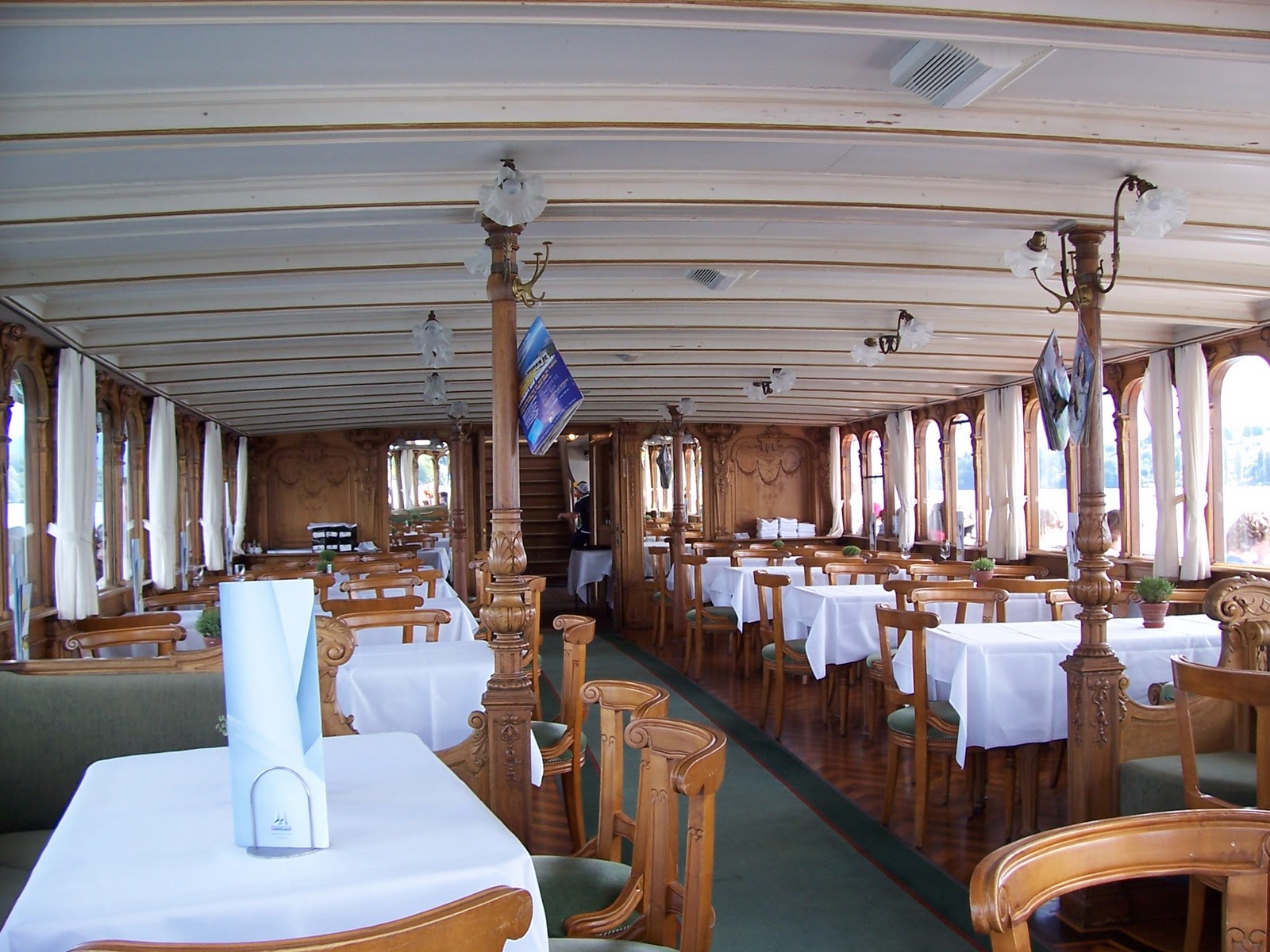
The first class saloon looking forward.

First class saloon looking aft.

Looking forward into the second class saloon from the engine. As part of the rebuild a retractable bulkhead will be installed to once again separate the saloon from the engine area.

The upper deck dining area as it was in 2008.

An early season shot from 2008, note the snow on Pilatus.

Paul Semple
|
Sunday, 19 December 2010
Inglis Shipyard becomes the Riverside Museum

As 2010 enters its final fortnight we reflect that next year will see the opening of the new £80m Riverside Museum (of Transport and maritime heritage) on Pointhouse Quay at the confluence of the Rivers Clyde and Kelvin. The titanium and glass clad museum building occupies the site of a famous Glasgow shipyard, the Pointhouse yard, opened in 1863 by the brothers Anthony and John Inglis, who had peviously built marine engines and other engineering products at their works in Warroch Street, off Anderston Quay. Inglis shipyard at Pointhouse was in production for almost exactly a century,during which time the firm produced about 500 ships of a range in size and type that would, undoubtedly, surprise the huge number of international tourists that will visit the Riverside Museum in the next few years. They were, of course, well known as builders of paddle steamers including Waverley and Maid of the Loch, two of the few remaining Clyde-built ships of this type. However, Inglis paddle steamers could be found much further afield than the home market - they featured in the fleets of the Bay Steamers company of Melbourne, South Australia, the earltest Yangtse-river steamers of Swire's China Navigation Company and, prominently, in the fleets of Nicolas Mihanovich and the Entre Rios Railway companies on the River Plate between Buenos Aires and Montevideo and further into the interior of the South American continent. The Mihanovich paddlers were significantly larger than their Clyde counterparts and the Entre Rios ships were built as train ferries rather than passenger boats.Other passenger ships produced by Inglis included around 50 small ocean going liners for the British India Steam Navigation Company, founded by Campbeltown-born Sir William MacKinnon, the largest shipping company in the world for a period prior to its merger with the Peninsula & Oriental Steam Navigation Company (P&O). Inglis first contribution to the Royal Navy was the destroyer HMS Fury in 1912 and, thereafter, they built numerous corvettes, frigates and patrol boats at Pointhouse. Arguably the most surprising of Inglis' contribution to the total of 26,000 plus ships built on Clydeside was their two Royal Yachts, the Safa-el-Bahr for the Kedive of Egypt and HMY Alexandra for the British Admiralty during the reign of HM King Edward VII. She finished her career as the coastal steamer Prins Olav on the famous Hurtigruten service in Norway. Ingis produced two ships in 1947 (any many unnamed barges), one being the vessel that has become well known as the world's last seagoing paddle steamer since 1971 and the other being the largest ship ever built in the Pointhouse shipyard, under subcontract from the Scotts Shipbuilding & Engineering Company of Greenock, the China Navigation Company's Soochow.
The picture above depicts Inglis' shipyard from the bridge over the River Kelvin in 1946. Nearest the camera is the Clyde paddle steamer Jeanie Deans (originally built at Fairfields on the opposite bank of the Clyde in Govan in 1931) undergoing a significant rebuild after over six years service in the Royal Navy as HMS Jeanie Deans during WW2. The vessel immediately astern of her and the vessel under construction in the yard are two of the four tankers, Empire Tedport, Empire Tedship, Empire Tedmuir and Empire Tedrita, built by Inglis in 1946-47. Finally, still in her austere wartime livery is the paddler HMS Aristocrat, then recently arrived after demob from the Royal Navy and ready to be converted back into her civilian role as the Clyde-based paddler Talisman. She was an Inglis product in 1935 when she broke new ground as the Clyde's first and, as it turned out, only diesel electric paddle vessel.
The high cranes in the background are those at the Govan shipyard of the huge Harland & Wolff shipbuilding group, of which the Inglis company had been a subsidiary since 1917. Although best known for their base at Queens Island in Belfast, from the 1920s to the 1960s Harland & Wolff's presence on the Clyde was almost as large as that on the Lagan. It Included 6 shipyards, the Finnieston (Steam) Engine Works at Anderston Quay, the Scotstoun (Diesel) Engine Works and the huge Clyde Foundry, one of the largest in Europe, in Helen Street Govan, which produced massive castings such as engine cylinder blocks, stern posts and rudder horns, etc.

Subscribe to:
Posts (Atom)

