
On Tuesday 12th October Waverley undertook a sell out cruise to view and escort newly delivered Cunard cruise ship Queen Elizabeth leaving Southampton on her Maiden Voyage.
This is the second cunarder Waverley has escorted in 2010, the first being QE's Vista class sister Queen Victoria when she visited Greenock in July.
Photos can be found here & here.
The Clyde sees visits from two of the Cunard fleet in Sept 2011 with Queen Elizabeth visiting as part of her round UK tour and flagship Queen Mary 2 as part of her round UK tour (in the opposite direction to QE) - this will be QM2's second visit to Greenock.
Showing posts with label Cunard. Show all posts
Showing posts with label Cunard. Show all posts
Wednesday, 13 October 2010
Thursday, 9 September 2010
Launch and Career of a Clydebuilt Icon to be celebrated.
The 43rd anniversary of the launch of the iconic Queen Elizabeth 2 is to be marked by events at her birthplace of Clydebank.
Waverley and QE2 met many times during the liner's long and illustrious career and I hope that members will take the time to support this event.
Clydebank ♥s the QE2! is an event organised by clyde walking tours™, in association with QE2 website and forum theqe2story.com and will consist of a 90 minute walking tour of Clydebank including the former site of the world famous shipbuilders John Brown and the area formerly occupied by the very slipway on which QE2 and many other famous liners were built and launched.
In the evening a 1 hour presentation on QE2 will be delivered by the qe2story's Rob Lightbody in the Cunard Suite, Clydebank College (College Square, Queens' Quay, G81 1BF).
For more details and to buy tickets please visit http://qe2.eventbrite.com/
Visit the internet's premier QE2 website and forum at http://www.theqe2story.com/index.html where you will find many many interesting facts, discussions and features on the world's most famous ocean liner - including Q&A sessions with two of the QE2's former masters!!
Waverley and QE2 met many times during the liner's long and illustrious career and I hope that members will take the time to support this event.
Clydebank ♥s the QE2! is an event organised by clyde walking tours™, in association with QE2 website and forum theqe2story.com and will consist of a 90 minute walking tour of Clydebank including the former site of the world famous shipbuilders John Brown and the area formerly occupied by the very slipway on which QE2 and many other famous liners were built and launched.
In the evening a 1 hour presentation on QE2 will be delivered by the qe2story's Rob Lightbody in the Cunard Suite, Clydebank College (College Square, Queens' Quay, G81 1BF).
For more details and to buy tickets please visit http://qe2.eventbrite.com/
Visit the internet's premier QE2 website and forum at http://www.theqe2story.com/index.html where you will find many many interesting facts, discussions and features on the world's most famous ocean liner - including Q&A sessions with two of the QE2's former masters!!
 |
| QE2 on the Clyde for the final time Oct 2008 © G Stewart |

Saturday, 23 January 2010
Coasts of Clyde
The following embedded links take you to YouTube versions of the classic British Transport Films' promotional documentary 'The Coasts of Clyde'. It is loaded in three parts (presumably due file size, bandwidth or some other restrictions). If interested you can buy higher resolution copies of this film on DVD.
I think this film demonstrates why there is still a band of 'steamer enthusiasts' that have kept the last of the Clyde steamers, Waverley, going for the last 35 years (the ship has now been in operational preservation for significantly longer than it was in commercial service - 27 years). Those of us on the wrong side of 50 can still recall with some fondness the days when there was a fleet of steamers on the Firth of Clyde. Waverley has been the sole survivor of the breed since 1978. The film includes views of the Clyde paddle steamers Jeanie Deans, Caledonia, Jupiter and Waverley and a brief clip of Maid of the Loch, which is currently statically preserved at Balloch on Loch Lomond. There is a very brief glimpse of three passenger steamers alongside Rothesay pier at the same time, something that most certainly will not happen again (at 3 mins 35 seconds in part 2). (The nearest that you can get to the Clyde steamer fleet feeling nowadays is to visit the paddle steamer fleets of the Lakes of Geneva and Lucerne in Switzerland - but you don't get the open sea feel there). The Rothesay clip depicts part of the paddler Caledonia at the Craigmore (near) end of the pier, the turbine steamer Queen Mary II berthed at the middle berth (Berth2), on one of her regular 'Doon-the-Watter' sailings from Glasgow Bridge Wharf to the Kyles of Bute, and the Waverley berthing at the Ardbeg end of the pier, a berth that she has recently started to use again following the significant remodelling of Rothesay pier. There is some 'artistic licence' at work in the making of the film e.g. the sequence describing the passage through the famous 'Narrows' of the Kyles of Bute involves two different paddle steamers - the first part shows Jeanie Deans entering the narrow channel from the East Kyle (at 4:41), the Jupiter passing through it (at 4:50) and back to the Jeanie Deans exiting the Narrows and turning to port to head down the West Kyle to Tighnabruaich (at 5:04).
Incidentally, I think the Cunard Line vessel at the start of Part 1 is the liner Media, which was a product of the John Brown shipyard at Clydebank in 1947, the same year that the Waverley was built by A & J Inglis upstream at Pointhouse. The Media stayed with Cunard only to 1961 when she was sold to Italian interests. In 1989, by which time she was named Lavia, she was gutted by fire at Hong Kong (07/01/1989) while undergoing renovation (an uncanny repeat of the fate of the famous Clydebank-built Cunarder Queen Elizabeth in 1972). Lavia was towed to shallow water where she heeled over onto her side on a sandbank. She was righted and towed to Kaohsiung in Taiwan, arriving 17/06/1989 for demolition. This was around the time of my first visit to Hong Kong by I didn't see her there.
Part 1
Part 2
Part 3
It was in those days that my enthusiasm for the Clyde and its ships and shipyards and particularly its excursion steamers was born. It was an advantage, undoubtedly, that my best pal at the old Burgh Primary School in Rutherglen at that time was Robert Dalgleish, whose grandparents lived in Dunoon. We became juvenile members of the Clyde River Steamer Club in the mid 1960s and I am still a member of the 78 year old club. The picture below shows Rab and myself enjoying a sail on the paddle steamer Caledonia, leaning back on the hatch covering the companionway down to the crew accommodation, right up near the bow of the steamer. The date was the 18th May 1968 and the Caledonia was on a special charter that day to the Rutherglen West Parish Church where Rab and I were members of the 38th Glasgow Scout Troop. The sailing had started at the Bridge Wharf in Glasgow and visited the Kyles of Bute and Loch Riddon. Many years later, as a final year undergraduate, Rab based his degree thesis on a study of the economics of operating steamers on the Clyde. Sadly, the Caledonia was withdrwn from service at the end of 1969, an event that encouraged the formation of the Scottish Branch of the Paddle Steamer Preservation Society. Although it proved impossible to keep the Caledonia operational theBranch members were successful in preventing her demolition and, in 1972 she began a new career as a static bar and restaurant on the River Thames at the former Savoy Pier just upstream of Waterloo Bridge. She continued in that role until badly damaged by a fire in 1981. Unfortunately the prospect of returning her to the Clyde for restoration as a possible running mate for Waverley could not be brought to fruition. She was replaced on the Thames by another Clyde Steamer, none other than the turbine steamer Queen Mary that also features in the film. She remained in the role until 2009. The vessel is currently being transferred to La Rochelle in western France for use as floating hotel.

Robert Dalgleish and me on PS Caledonia, 18th May 1968
Stuart Cameron
I think this film demonstrates why there is still a band of 'steamer enthusiasts' that have kept the last of the Clyde steamers, Waverley, going for the last 35 years (the ship has now been in operational preservation for significantly longer than it was in commercial service - 27 years). Those of us on the wrong side of 50 can still recall with some fondness the days when there was a fleet of steamers on the Firth of Clyde. Waverley has been the sole survivor of the breed since 1978. The film includes views of the Clyde paddle steamers Jeanie Deans, Caledonia, Jupiter and Waverley and a brief clip of Maid of the Loch, which is currently statically preserved at Balloch on Loch Lomond. There is a very brief glimpse of three passenger steamers alongside Rothesay pier at the same time, something that most certainly will not happen again (at 3 mins 35 seconds in part 2). (The nearest that you can get to the Clyde steamer fleet feeling nowadays is to visit the paddle steamer fleets of the Lakes of Geneva and Lucerne in Switzerland - but you don't get the open sea feel there). The Rothesay clip depicts part of the paddler Caledonia at the Craigmore (near) end of the pier, the turbine steamer Queen Mary II berthed at the middle berth (Berth2), on one of her regular 'Doon-the-Watter' sailings from Glasgow Bridge Wharf to the Kyles of Bute, and the Waverley berthing at the Ardbeg end of the pier, a berth that she has recently started to use again following the significant remodelling of Rothesay pier. There is some 'artistic licence' at work in the making of the film e.g. the sequence describing the passage through the famous 'Narrows' of the Kyles of Bute involves two different paddle steamers - the first part shows Jeanie Deans entering the narrow channel from the East Kyle (at 4:41), the Jupiter passing through it (at 4:50) and back to the Jeanie Deans exiting the Narrows and turning to port to head down the West Kyle to Tighnabruaich (at 5:04).
Incidentally, I think the Cunard Line vessel at the start of Part 1 is the liner Media, which was a product of the John Brown shipyard at Clydebank in 1947, the same year that the Waverley was built by A & J Inglis upstream at Pointhouse. The Media stayed with Cunard only to 1961 when she was sold to Italian interests. In 1989, by which time she was named Lavia, she was gutted by fire at Hong Kong (07/01/1989) while undergoing renovation (an uncanny repeat of the fate of the famous Clydebank-built Cunarder Queen Elizabeth in 1972). Lavia was towed to shallow water where she heeled over onto her side on a sandbank. She was righted and towed to Kaohsiung in Taiwan, arriving 17/06/1989 for demolition. This was around the time of my first visit to Hong Kong by I didn't see her there.
Part 1
Part 2
Part 3
It was in those days that my enthusiasm for the Clyde and its ships and shipyards and particularly its excursion steamers was born. It was an advantage, undoubtedly, that my best pal at the old Burgh Primary School in Rutherglen at that time was Robert Dalgleish, whose grandparents lived in Dunoon. We became juvenile members of the Clyde River Steamer Club in the mid 1960s and I am still a member of the 78 year old club. The picture below shows Rab and myself enjoying a sail on the paddle steamer Caledonia, leaning back on the hatch covering the companionway down to the crew accommodation, right up near the bow of the steamer. The date was the 18th May 1968 and the Caledonia was on a special charter that day to the Rutherglen West Parish Church where Rab and I were members of the 38th Glasgow Scout Troop. The sailing had started at the Bridge Wharf in Glasgow and visited the Kyles of Bute and Loch Riddon. Many years later, as a final year undergraduate, Rab based his degree thesis on a study of the economics of operating steamers on the Clyde. Sadly, the Caledonia was withdrwn from service at the end of 1969, an event that encouraged the formation of the Scottish Branch of the Paddle Steamer Preservation Society. Although it proved impossible to keep the Caledonia operational theBranch members were successful in preventing her demolition and, in 1972 she began a new career as a static bar and restaurant on the River Thames at the former Savoy Pier just upstream of Waterloo Bridge. She continued in that role until badly damaged by a fire in 1981. Unfortunately the prospect of returning her to the Clyde for restoration as a possible running mate for Waverley could not be brought to fruition. She was replaced on the Thames by another Clyde Steamer, none other than the turbine steamer Queen Mary that also features in the film. She remained in the role until 2009. The vessel is currently being transferred to La Rochelle in western France for use as floating hotel.

Robert Dalgleish and me on PS Caledonia, 18th May 1968
Stuart Cameron
Monday, 6 October 2008
Balmoral Salutes a Retiring Legend
(Clicking on most of the new pictures below will open a larger high resolution view)
On Sunday 5th October the veteran Waverley Excursions motor ship Balmoral played a significant part in the final visit of one of the greatest ships that the world has ever known to the river of her birth . The celebrity was, of course, RMS Queen Elizabeth 2 the last of the great Clydebuilt passenger liners. The QE2 was built at the former John Brown shipyard in Clydebank and was to be the last of many fine passenger liners built on the river. In fact, the majority of the ships built for the famous Cunard Line were built on the Clyde (122 in total) and, when the QE2 is handed over to her new owners in Dubai in December 2008, it will be the first time in its near 170-year history that the Cunard fleet has not had at least one Clydebuilt ship in its number.
The first four Cunard liners were paddle steamers designed according to the advice of the renowned Clyde engineer and shipbuilder Robert Napier. The first of the four was the PS Britannia. At the time of her construction in 1839 Napier had yet to establish his shipyard at Govan near Glasgow, so the hull of Britannia an her sisters where built by several shipyards on the lower Clyde and towed up river to Napier’s Dock to have all of their machinery installed. Napier's Dock was at the eastern end of what is now Lancefield Quay, now Waverley Steam Navigation's office and workshop. His marine engine building works was in the adjacent Hydepark Street.

Although the Cunard Line (founded by Canadian Samuel Cunard) was long associated with the port of Liverpool, its headquarters, a lot of the capital raised to finance the Company and its early fleet of vessels was raised on Clydeside, principally by the established shipowner George Burns. The partnership regaled under the impressive title of the ‘ Glasgow Propriety in the British & North American Royal Mail Steam Packet Company’. Details of the Burns family's influential position in the development of steam navigation can be found here. In fact, the Company did not change its name to the Cunard Steamship Company until after the death of its founder in the 1880s. Again, while most of the Line’s ships, prior to the QE2, were registered in the port of Liverpool, the early fleet of ships were registered in Glasgow. After Napier established his new shipyard in the 1850s one of the first ships that he built there was the huge paddle steamer Persia for Cunard. She was the largest merchant ship in the World at the time of her construction.

The last ocean-going paddle steamer built by Napier for Cunard was the PS Scotia, launched at Govan on the 25th June 1861.

As the Cunard ships became bigger the principal builder became the Fairfield Shipbuilding & Engineering Company, set up by the brilliant shipbuilder and engineer John Elder, a pupil of Napier. John Elder’s father David Elder was Napier’s highly regarded foreman for many years. The huge screw steamers Campania and Lucania represented the peak of Fairfield’s contribution to Cunard.
 RMS Campania, Cunard's Record Breaker
As the 19th Century drew to a close, and Cunard’s liners became so large that the main production of liners for Cunard moved yet further down the Clyde to Clydebank where the shipbuilders J & G Thomson had established a sizable state-of-the art shipyard directly opposite the location where the River Cart flows into the Clyde. That location was to become more important as the 20th Century progressed.
Early in the 20th Century the Cunard Line, by then under the chairmanship of Baron Inverclyde of Wemyss Bay, was facing a substantial threat from large American concerns,. Lord Inverclyde negotiated assistance from the British Government for the construction of two huge new liners to fend off the American challenge. The sister ships were Mauritania (built on Tyneside) and Lusitania, which was built at Clydebank, by then under the ownership of John Brown & Co.. The relationship between Cunard and Brown’s lasted for over sixty years with many of its finest and largest ships built at Clydebank. The building of the progressively larger Cunarders was only possible at Clydebank due to the River Cart opposite , which eliminated the restriction imposed by the relatively narrow River Clyde. The decision to locate the yard there was an inspired choice by those that could not have known of the giant liners that were to be built in the next century. Consequently, world renowned Cunarders such as Aquitania, Queen Mary, Queen Elizabeth and Caronia were all created at Clydebank and the association continued with the order for Yard No 736, which became QE2 on her launch in Sept 1967. Sadly, she was to be the last prestige Cunarder to be built at Clydebank, or anywhere else on the Clyde.
In 2007, when the announcement came that QE2 was to retire to Dubai as a floating hotel (just as her illustrious predecessor, Queen Mary, done at Long Beach, California in 1967) there was some considerable regret that the strong link between Clydebuilt vessels and the Cunard fleet, dating back to the very founding of the Company, was finally to end. The final visit of the ship to Clydeside, on 5th October 2008, was going to be filled with an emotion that only shipbuilding and maritime communities can fully appreciate.
The Balmoral was rostered to participate in that great event. In fact, though not a Clydebuilt ship, Balmoral had a significant association with QE2 as the liner was to be the first Cunarder to be registered in the port of Southampton, which had replaced Liverpool as the Line’s main base port many years earlier. Balmoral was also registered in Southampton as she served the Isle of Wight from the city in her first life (subsequently, when she was acquired by Balmoral Excursions Ltd in 1986, her registry was switched to Bristol).
QE2 first returned to the river of her birth in 1990 when she was escorted by PS Waverley and the paddler had greeted the liner 'home' on subsequent visits in the 1990s. Balmoral had assumed the role in 2007 when she accompanied the departing Cunarder almost as far as Toward after her visit to the Clyde for the 40th anniversary of her launch in 1967. See pictures of the launch and the 40th anniversary visit here.
Due to different timings for the liner’s last ever return to Clydeside, the Balmoral was able to join a large flotilla of craft including the Royal Navy destroyer HMS Manchester that escorted the liner on her arrival. So at the early time (for a Sunday) of 0900 an almost capacity quota of passengers joined the 59-year old motor ship at Greenock’s Customhouse Quay to go and meet the liner. After a unprecedentedly poor summer (even the previous day was horrible), the 5th October 2008 dawned with an almost cloudless blue sky. It was almost like a dream that the weather could be so good and undoubtedly it added immensely to the enjoyment of the tens of thousands of people who came to see the Clyde’s last great liner for the last time.

Queen Elizabeth 2 had served, like her predecessors, as a troopship in time of conflict (Falklands War 1982) and as a mark of that the Royal Navy honoured ‘our old friend’ by assigning the Type 42 destroyer HMS Manchester to escort the liner from the lower Firth of Clyde to the famous ‘Tail of the Bank’ anchorage off Greenock .

The magnificent QE2 arrives back on the Clyde for the last time

After the extremely successful escort sailing Balmoral left Greenock for Glasgow to bring another near capacity crowd of passengers to view the liner at the Ocean Terminal at Greenock. As an added bonus Balmoral cruised around a number of large naval vessels that were at anchor off Greenock in preparation for extensive naval exercises off the West Coast.

Balmoral heading upriver to Glasgow


Within the next decade both of these vessels may be replaced by new tonnage under construction on the Clyde and elsewhere, Manchester by one of the six Type 45 destroyers currently under construction at Scotstoun and Govan and Ark Royal by the new aircraft carriers HMS Queen Elizabeth and HMS Prince of Wales (the largest sections of which will be constructed at Govan)

Balmoral headed back upriver to Glasgow to embark yet another near capacity crowd before setting sail to join the flotilla that escorted magnificent QE2 away from the Clyde – all in darkness so no pictures I’m afraid.

Capt Andy O'Brian, Waverley Excursions senior master takes Balmoral away from Greenock.
Balmoral’s season is over and it is no secret that it has been a most disappointing one. Therefore, it was good to see her so busy on that most unforgettable of days. Next year is her Diamond Jubilee. Let us hope it will bring her the passengers that she deserves to have.
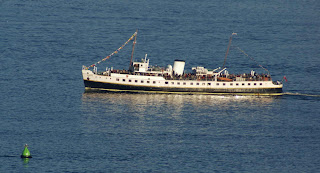 Balmoral's 2008 season ended on a high with three full load sailings in an unforgetable day

On Sunday 5th October the veteran Waverley Excursions motor ship Balmoral played a significant part in the final visit of one of the greatest ships that the world has ever known to the river of her birth . The celebrity was, of course, RMS Queen Elizabeth 2 the last of the great Clydebuilt passenger liners. The QE2 was built at the former John Brown shipyard in Clydebank and was to be the last of many fine passenger liners built on the river. In fact, the majority of the ships built for the famous Cunard Line were built on the Clyde (122 in total) and, when the QE2 is handed over to her new owners in Dubai in December 2008, it will be the first time in its near 170-year history that the Cunard fleet has not had at least one Clydebuilt ship in its number.
The first four Cunard liners were paddle steamers designed according to the advice of the renowned Clyde engineer and shipbuilder Robert Napier. The first of the four was the PS Britannia. At the time of her construction in 1839 Napier had yet to establish his shipyard at Govan near Glasgow, so the hull of Britannia an her sisters where built by several shipyards on the lower Clyde and towed up river to Napier’s Dock to have all of their machinery installed. Napier's Dock was at the eastern end of what is now Lancefield Quay, now Waverley Steam Navigation's office and workshop. His marine engine building works was in the adjacent Hydepark Street.

The first Cunard paddler Britannia
(Cunard Archives)
Although the Cunard Line (founded by Canadian Samuel Cunard) was long associated with the port of Liverpool, its headquarters, a lot of the capital raised to finance the Company and its early fleet of vessels was raised on Clydeside, principally by the established shipowner George Burns. The partnership regaled under the impressive title of the ‘ Glasgow Propriety in the British & North American Royal Mail Steam Packet Company’. Details of the Burns family's influential position in the development of steam navigation can be found here. In fact, the Company did not change its name to the Cunard Steamship Company until after the death of its founder in the 1880s. Again, while most of the Line’s ships, prior to the QE2, were registered in the port of Liverpool, the early fleet of ships were registered in Glasgow. After Napier established his new shipyard in the 1850s one of the first ships that he built there was the huge paddle steamer Persia for Cunard. She was the largest merchant ship in the World at the time of her construction.

PS Persia under construction at Robert Napier's Clyde shipyard
(source unknown)
(source unknown)
The last ocean-going paddle steamer built by Napier for Cunard was the PS Scotia, launched at Govan on the 25th June 1861.

Model of PS Scotia, Cunard's largest and last ocean going paddle steamer
(Model at the Science Musuem, South Kensington, London)
As the Cunard ships became bigger the principal builder became the Fairfield Shipbuilding & Engineering Company, set up by the brilliant shipbuilder and engineer John Elder, a pupil of Napier. John Elder’s father David Elder was Napier’s highly regarded foreman for many years. The huge screw steamers Campania and Lucania represented the peak of Fairfield’s contribution to Cunard.
 RMS Campania, Cunard's Record Breaker
 (Model at the Science Museum, South Kensington, London)
As the 19th Century drew to a close, and Cunard’s liners became so large that the main production of liners for Cunard moved yet further down the Clyde to Clydebank where the shipbuilders J & G Thomson had established a sizable state-of-the art shipyard directly opposite the location where the River Cart flows into the Clyde. That location was to become more important as the 20th Century progressed.
Early in the 20th Century the Cunard Line, by then under the chairmanship of Baron Inverclyde of Wemyss Bay, was facing a substantial threat from large American concerns,. Lord Inverclyde negotiated assistance from the British Government for the construction of two huge new liners to fend off the American challenge. The sister ships were Mauritania (built on Tyneside) and Lusitania, which was built at Clydebank, by then under the ownership of John Brown & Co.. The relationship between Cunard and Brown’s lasted for over sixty years with many of its finest and largest ships built at Clydebank. The building of the progressively larger Cunarders was only possible at Clydebank due to the River Cart opposite , which eliminated the restriction imposed by the relatively narrow River Clyde. The decision to locate the yard there was an inspired choice by those that could not have known of the giant liners that were to be built in the next century. Consequently, world renowned Cunarders such as Aquitania, Queen Mary, Queen Elizabeth and Caronia were all created at Clydebank and the association continued with the order for Yard No 736, which became QE2 on her launch in Sept 1967. Sadly, she was to be the last prestige Cunarder to be built at Clydebank, or anywhere else on the Clyde.

In 2007, when the announcement came that QE2 was to retire to Dubai as a floating hotel (just as her illustrious predecessor, Queen Mary, done at Long Beach, California in 1967) there was some considerable regret that the strong link between Clydebuilt vessels and the Cunard fleet, dating back to the very founding of the Company, was finally to end. The final visit of the ship to Clydeside, on 5th October 2008, was going to be filled with an emotion that only shipbuilding and maritime communities can fully appreciate.
The Balmoral was rostered to participate in that great event. In fact, though not a Clydebuilt ship, Balmoral had a significant association with QE2 as the liner was to be the first Cunarder to be registered in the port of Southampton, which had replaced Liverpool as the Line’s main base port many years earlier. Balmoral was also registered in Southampton as she served the Isle of Wight from the city in her first life (subsequently, when she was acquired by Balmoral Excursions Ltd in 1986, her registry was switched to Bristol).
QE2 first returned to the river of her birth in 1990 when she was escorted by PS Waverley and the paddler had greeted the liner 'home' on subsequent visits in the 1990s. Balmoral had assumed the role in 2007 when she accompanied the departing Cunarder almost as far as Toward after her visit to the Clyde for the 40th anniversary of her launch in 1967. See pictures of the launch and the 40th anniversary visit here.
Due to different timings for the liner’s last ever return to Clydeside, the Balmoral was able to join a large flotilla of craft including the Royal Navy destroyer HMS Manchester that escorted the liner on her arrival. So at the early time (for a Sunday) of 0900 an almost capacity quota of passengers joined the 59-year old motor ship at Greenock’s Customhouse Quay to go and meet the liner. After a unprecedentedly poor summer (even the previous day was horrible), the 5th October 2008 dawned with an almost cloudless blue sky. It was almost like a dream that the weather could be so good and undoubtedly it added immensely to the enjoyment of the tens of thousands of people who came to see the Clyde’s last great liner for the last time.

Balmoral, dressed fore and aft for the special day at Greenock about 0900.
Queen Elizabeth 2 had served, like her predecessors, as a troopship in time of conflict (Falklands War 1982) and as a mark of that the Royal Navy honoured ‘our old friend’ by assigning the Type 42 destroyer HMS Manchester to escort the liner from the lower Firth of Clyde to the famous ‘Tail of the Bank’ anchorage off Greenock .

The magnificent QE2 arrives back on the Clyde for the last time

HMS Manchester escorted QE2 from the lower Firth of Clyde to the Tail of the Bank
After the extremely successful escort sailing Balmoral left Greenock for Glasgow to bring another near capacity crowd of passengers to view the liner at the Ocean Terminal at Greenock. As an added bonus Balmoral cruised around a number of large naval vessels that were at anchor off Greenock in preparation for extensive naval exercises off the West Coast.

Balmoral heading upriver to Glasgow

Balmoral passing QE2 on her second special sailing

Balmoral passing the Royal Navy aircraft carrier HMS Ark Royal
(with the classic motor cruiser Fenella in the foreground)
(with the classic motor cruiser Fenella in the foreground)

Balmoral ‘threading the needle ‘ between HMS Ark Royal and the destroyer HMS Manchester.
Waverley's original base, the derelect remains of Craigendoran pier, can be seen in the Background
Waverley's original base, the derelect remains of Craigendoran pier, can be seen in the Background
Within the next decade both of these vessels may be replaced by new tonnage under construction on the Clyde and elsewhere, Manchester by one of the six Type 45 destroyers currently under construction at Scotstoun and Govan and Ark Royal by the new aircraft carriers HMS Queen Elizabeth and HMS Prince of Wales (the largest sections of which will be constructed at Govan)

Balmoral having a brief look at the RFA Mounts Bay (built upriver at Govan) and HMS Bulwark, constructed at Barrow-in-Furness. Bulwark's landing craft were also built at Govan.
Balmoral headed back upriver to Glasgow to embark yet another near capacity crowd before setting sail to join the flotilla that escorted magnificent QE2 away from the Clyde – all in darkness so no pictures I’m afraid.

Capt Andy O'Brian, Waverley Excursions senior master takes Balmoral away from Greenock.
Balmoral’s season is over and it is no secret that it has been a most disappointing one. Therefore, it was good to see her so busy on that most unforgettable of days. Next year is her Diamond Jubilee. Let us hope it will bring her the passengers that she deserves to have.
 Balmoral's 2008 season ended on a high with three full load sailings in an unforgetable day
QE2 has gone from the Clyde and we know that we will never see her likes again here.
(More General pictures of the QE2 visit on alternative website - links to follow)
All pictures by Stuart Cameron except where indicated
Subscribe to:
Posts (Atom)

