After two years as Chairman of the Scottish Branch, Stuart Mears decided to stand down at the recent branch AGM held on Friday 16th April in Glasgow. Having been Stuart's Vice Chairman for the same period the "baton" was handed to me for the next two years. For those of you who dont know me my name is Gavin Stewart, I live in Greenock though originally hail from West Kilbride on the Ayrshire coast.
I became involved with Waverley / PSPS in 2004 when myself and my partner Shelagh began attending Work Parties on the ship during the winter. I was asked to join the branch committee in 2005 and took over the role of Exhibitions Manager in 2006 - the same year as Shelagh came onto committee. 2008 saw me join the Council of Management of the Society and become Vice Chairman of the branch. My background is in Electrical Engineering and I currently work at Howden Process Compressors in Renfrew - originally James Howden & Co who are a long established Scottish engineering company.
So there you have it - a potted history of your new Chairman! Can I take this opportunity to thank Stuart for all his efforts during the last two years and thank him for agreeing to stay on as a member of the branch commitee. I also have the pleasure of welcoming Paul Semple on board. Paul is well known in Waverley circles and will be a great asset to the branch. Stuart Cameron also rejoins us after an absence of a year as does Michael Hughan who will continue to keep us abreast of happenings with Scotland's other paddler Maid of the Loch.
So who is the Vice Chairman I hear you ask?? Well none other than "Uncle" Peter Reid - one of the original group who set the whole thing going back in 1974. No pressure there then!!
Anyway - back to the present day and our ship!
New Season
You will have seen from the previous post that our paddler is now safely docked down in Garvel Drydock, Greenock for her annual overhaul. She is expected to emerge on Monday 10th May when she will head out to the Tail O the Bank for compass adjustment before proceeding back up river to her Glasgow Science Centre berth where work will continue to ready her for the forthcoming season which starts at 7am on Friday 28th May with the annual trip to Oban for the weekend.
This season will present the same set of challenges as before - fuel continues to be a major issue and the recent steady increase in cost at the pumps equates to a similar increase for Waverley even though she doesn't (thankfully!!) run on pump fuel!! Couple this with the unpredictable climate (at least she won't be affected by volcanic ash issues) and you can see why operating the World's Only Seagoing Paddle Steamer is no walk in the park.
We can all play a part in facing this challenge - by sailing on our ships and also encouraging others to come along and share the pleasures of a relaxing day out on the river watching the world paddle past. Leave your cares ashore and collect them on your return.............
So on that note I'll sign off - below are some more excellent shots of Waverley's trip to Greenock on Wednesday taken by Gerry Deegan.
A sure sign that summer is coming (or at least that part of the year that used to be summer) - Waverley made her first voyage of 2010 yesterday when she paddled down from Glasgow to Greenock and entered Garvel Graving Dock for her pre-season overhaul. In fact the vessel looks remarkably good going into the dock - a happy condition for which we must thank all of her winter crew and her loyal band of able volunteers
This link takes you to a short video of the vessel entering the dock - one of Gerry Ward's excellect Clutha Films
Update on Progress at the Albion Dockyard, Bristol. (Words G Stewart - Pics Dave Elms)
Almost 12 months have passed since our last article on this historic project and work has been continuing apace at Albion Dry Dock, Bristol.
Time to catch up then!!
On Thursday 15th October this project reached a major milestone when the first hull block was removed from the fabrication shed and placed onto the keel blocks in the drydock. More on this story can be found on the Medway Queen Website
Fabrication has continued in the dry dock with more blocks being added. Click on an image to view a larger version.
Jan 2010
A rivetted hull requires a frame onto which the plating is rivetted. This frame consists of vertical sections (which are formed into the correct profile to give the hull the correct shape) and transverse frames which run port to starboard and are fixed to the vertical items. The vertical frames are in turned rivetted to keel. The shot below shows frames for the forward section of the hull ready to be erected.
The next photo below shows the hull in dry dock from the framed bow back to midships - with a section still to be framed. Note the smooth curve in the transverse frames - this is called camber and adds strength to the structure. In the case of open decks this also assists with drainage to the scuppers during inclement weather.
Another view of the hull looking from the after end. The two large bulkheads in the foreground of the shot divide the engine and boiler compartments. Note the opening for an access door.
A close up shot of the forementioned bulkheads. The one being positioned in the foreground is the screen bulkhead which will support the transverse heavy beam onto which the main engine entablatures will attach - the exact part is labelled 'B' in Part 2 of this series.
Back into the workshop for the next shot - here we see the top half of the "fore peak" bulkhead. The fore peak is the very front of the ship which terminates with the stem. This bulkhead incorporates a watertight access door. This piece will fit between the Main & Promenade decks and is situated on top of the bulkhead which forms the back of the anchor chain locker.
The "enclosure" in the right of the shot will be the Spirits Locker.
Feb 2010
Moving on this next shot from the dock floor shows most of the frames from the stem to midships have been erected to Main Deck Level.
This next shot shows the two heavy frames which will provide support the main engine entablatures and in turn the crankshaft and paddle shafts. As well as the forementioned support function this section of the ship must be heavier built as it has to withstand the thrust generated by the propulsion system which will drive the hull through the water - too light and the frames may distort causing misalignment or in an extreme situation structural failure.
As hull fabrication continues focus is slowly but surely turning to the machinery. Large items such as the Main Engine Block and Condenser must be installed in the hull before fabrication reaches a stage which precludes the easy installation of these pieces but before this can be carried out the pieces must be inspected and remedial / replacement works effected as required.
This next shot shows the Main Engine Cylinder Block in the workshop ready to be assessed for refurbishment. The steam enters the HP cylinder via the HP Valve. The pressure at which it is admitted is regulated by the Main Steam Inlet Valve which is in turn connected to the throttle lever. Controlling this determines how fast the engine will operate. The spent steam from the HP travels to the LP via the route shown by the blue arrow. It is then used by the LP cylinder and finally condensed back into water and returned to the Boiler Feedwater Recovery System for re-use.
The equipment shown below is part of the Boiler Feedwater Recovery System. This is the air pump and it takes the output from the condenser, de-aerates it and passes it onto the hot well, which is the holding tank for recovery boiler feedwater. As with most ancillary equipment the air pump can be driven either by its own little steam engine or via a linkage from the Main Engine. This usually depended on the engine builder or the spare steam capacity available from the boiler to drive the ancillary equipment.
Finally we look at a boiler feedwater pump which, as the name suggests, pumped water into the boilers to be converted to steam to drive the ship. Medway Queen appears to have had only one of these but some ships (eg Waverley) had two which operate on a rota basis. It is these pumps which make the familiar whooping noise on Waverley.
So the works proceed apace - thanks once again to Dave Elms for providing the shots. If you want more information why not visit the Medway Queen Shipyard Blog or look in on the Albion Drydock Webcam
Dear All, By the time you read this, you should have had a letter in your latest Paddle Wheels concerning, our offer of the PS Lincoln Castle currently moored in Grimsby. I will avoid muddying the waters with too much detail about the visit and my impressions, as one of the chief drivers as to what happens next will be the surveyors report, based on fact, rather than my relatively uneducated impressions based on a cursory visual inpsections.
It is however vitally important that we know "the will of the people" so please please please take the time to respond to the questionaire in the letter. If we are to move forward on this it must be in the knowledge that this is a move broadly supported by the membership. Equally if we let her go for scrap (this is the alternative intended, albeit with great reluctance by the owner if we do not proceed) it must be in the knowledge that this is because this is what the society as a whole believed appropriate.
The idea behind this blog is simply to let you have a good look round the ship, inside and out.
These three pictures give a general view of the ship as she is berthed in Grimsby, by the very well signposted Fishing Heritage Centre.
The first place we visited was the car deck and the equivalent on Waverley of the Promenade Deck. The original wood decking has been overlaid with steel chequer plate. Of note along the starboard side is the added bar structure which, it would not be too unkind to say probably began life as a large garden shed at B & Q! What these photos fail to convey is the vast expanse of deck space. With the sponsons extending well aft, there really is a huge amount of space.
As the rain was getting heavier we retreated indoors for a look around the engine room. Considering that the vessel was operating as a pub /resturant, a suprising amount of loving care had been lavished on the non revenue earning part of the ship - and with a flick of a switch, the owner had the engines turning for us!
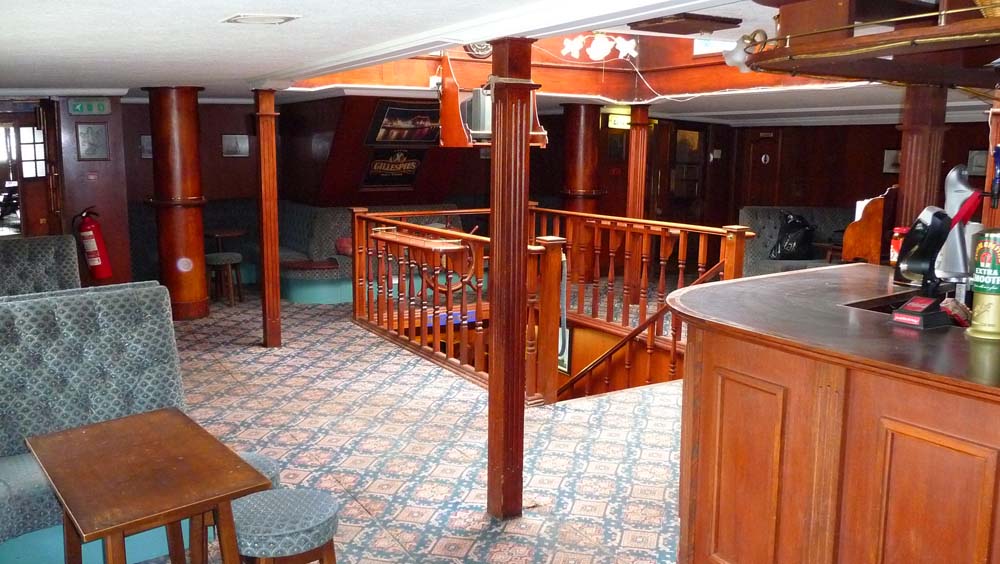
Next a look at the lower deck passenger spaces. First off, the "Grand staircase" leads down from the port and starboard alleyways to the lower bar aft. Almost exected to see Kate Winslet make a grand arrival, Titanic style! The lower bar has a significantly greater amount of headroom than Waverley, about 7 ft anyway. The next pic is in the lower bar forward area, the equivalent of the entire crew accomodation space on Waverley.
What I haven't shown here are photos I took of where the boiler used to be which is now a rather modern looking galley and each of the bunkers which are now bar and catering stores.
Above, some view from the main deck forward bar. The first view is looking aft, down the starboard side. Again it's hard to convey the size if this space which is filled somewhat by having the bar bang in the middle! The next photo is looking aft from further back on the starboard side and I guess the stairs leading down to the lower forward bar as described above are roughly in the same position as the crew accomodation stairs on Waverley.
I also took a fair few photos of things like the bilges for the purposes of a technical record but they are, to be honest, a bit boring for inclusion here! In any event, matters such as the material condition ohe shell plating are best left to be determined by the surveyor. There are cement repairs in the bilges as a means of addressing "pinholing". They vary from about 1/2 thick screeding, up to about 2-3" thick rather than the image most of us might have of a cement Box Repair of wooden shuttering surrounding about a foot deep block of cement. However I must repeat these visual observations are largely worthless and will be much better informed by the surveyor's report.
During the SS Sir Walter Scott rededication day on Loch Katrine last year the 110 year old steam ship was joined (temporarily) by 2 steam launches. At the following link you can see Neil Warbrick's pictures of the splendid steam launch Dalmore (with a familiar face on board) at the event:
A few YouTubes just to get you in the mood for Waverley's upcoming visit to the Inner Hrbrides in late May (with apologies for the almost legendary YouTube mis-match of audio and video - outwith the poster's control!):
The first part is taken from a production called 'Highland Voyage', which was based on the crew of a 'puffer' on he West Coast of Scotland.
A 'puffer' is a steam lighter, a type of small cargo vessel developed for use on the west coast of Scotland - they could be no longer than 66 feet so that they would fit in the locks of the Forth & Clyde Canal but the 'outside boats' had to be good enough sea-boats to take on the Atlantic swell as they plied their trade, summer and winter, to the Inner and Outer Hebrides. Often, when there was no convenient harbour or pier, they would intentionally run over a sandy beach at mid tide and wait until the tide went out, resting on their flat bottom, before discharging their cargo of coal or whatever directly into a horse drawn cart or lorry on the beach. They had sturdy hulls in case they rested onto a projecting rock which could set-up the keel but most of the old time puffer skippers knew the landing beaches like the lines on the back of their hands. The name 'puffer' originated from the early boats which were fitted with a simple expansion (single cylinder), reciprocating steam engine with no condenser or air pump. Therefore, the exhaust steam from the engine was emitted via the funnel to atmosphere as puffs of condensate with each stroke of the engine. There was an accompanying sound but, from a distance, you would see the 'puff' before you heard it (due to the relative speed of light and sound - something you can still experience if you are Watching Waverley from a distance when the steam whistle is blown). The puffer engine drow a single screw propeller fitted on the centreline. As a result you couldn't 'kick' the stern in the way that you can with modern twin screw coaster. This was usually offset partly by a very large rudder (but usually not a balanced one). Puffer skippers were good ship handlers - they had to be given some of the tight locations that they had to get their vessels into and out of without the assistance of modern aids such as bow thrusters and echo sounders.
The biggest firm of Puffer operators were J & J Hay, which also built many of their own fleet and for other fleets at their shipyard at Kirkintilloch on the F&C Canal. Nowadays, Kirkintilloch is not commonly thought of as a centre of shipbuilding but at one time it had two busy shipyards churning out many new vessels each year and carrying out repair and maintenance of existing boats. The history of shipbuilding at 'Kirkie' is a fascinating one in itself, well related in the late Ian Bowman's book 'Kirkintilloch Shipbuilding' published by Strathkelvin District Libraries in 1983 (sadly long out of print now)
The 'crew' of the puffer in the 'Highland Voyage' were composed of Scottish actors Duncan Macrae (skipper), Roddy McMillan (the 'Mate',who later played the role of skipper Para Handy in he 1960s version of the TV series 'The Vital Spark'), Alex Mackenzie (who played Peter MacTaggart, the skipper of the puffer that was the central theme of the 1954 Ealing Studios movie called 'The Maggie') and John Grieve (who played the part of the deckhand in Highland Voyage but is much better remembered for his portrayal of Dan Macphail, the legendary 'enchineer' of the Vital Spark.
The 1960s BBC Scotland series 'The Vital Spark' with Roddy McMillan as the skipper Para Handy (Peter MacFarlane), Walter Carr playing the Mate, Dougie and John Grieve playing engineer Dan MacPhail was loosely based on Neil Munro's 'Para Handy Tales'. The later (1990s) BBC Scotland series 'The Tales of Para Handy', with Gregor Fisher playing the role of Para Handy and Rikki Fulton as Dan Macphail, was more closely based on Munro's original work.
The deck scenes in 'Highland Voyage' were shot on the puffer Saxon, a product of Hay's yard at Kirkintilloch and mainly remembered nowadays for its association with the town of Millport on the Isle of Great Cumbrae.
The Second part has some gems in it including Duncan Macrae recitation of the 'Puffers Voyage' followed up by John Grieve's unforgettable rendition of 'Its the Crinan Canal for Me!'. The puffer in the Canal shots is the 'Toward Lass, one of the last surviving of the traditional puffers which is still well remembered from her latter years at her base in the Victoria Harbour in Greenock - her main duties latterly were a regular, short run across the Firth to remove 'trash' and scrap from the controversial American sumarine base at Holy Loch . She and her sisters Cloch Lass and Cumbrae Lass (all named after prominent Clyde lighthouses) were owned originally by the Burke family from Ettrick Bay on the Isle of Bute.
The concluding part has a wee bit repetition but is well worth the watching - also a kind of time warp with a much later excerpt of the 1970s MacBrayne Small Isles mail boat Lochmor, which also ran through the Sound of Sleat and the fast tide race in the Kylerhea on the service between the great herring port of Mallaig, terminus of the North British Railway Company's West Highland Railway and the Skye Railway terminus at Kyle of Lochalsh. Obviously this was not part of the original 'Highland Voyage' film but I think it comes from a BBC Scotland compilation, part of which was a nostalgic commentary by John Grieve (I think it was made not long before he died). Sadly, it is a few years now since Waverley made the sailing up to Kyle and it is not included in her 2010 schedule. This is regretable because the sailings that she has run up to Portree and beyond are amongst the finest that she has ever done but latterly the support for these midweek sailings has not been sufficient to justify her visits. Those that have managed to do these sailings in the past will be hopeful that they can be repeated, at least occasionally, in future. The scenery, including unsurpassable views of the Black and the Red Cuillins, especially in the gloaming with the sun setting in the west, is awesome (a much overworked word but justified in this instance).
Slightly off-subject but another bit of nostalgia for those of us that have been sailing through the Hebrides for as long as we can remember - the following film comprises rare footage of the construction of the three sister ships Hebrides, Clansman and Columba during their building and launch from the Hall Russell shipyard in Aberdeen in 1963-64. I barely remember this (I was only 7 years old at the time) but I can clearly remember my first sailing on any of the three ships - on the Columba from Oban to Craignure and Lochaline some time in 1964. It was a day most memorable for the almost incessant rain which forced us to stay inside the comfortable and warm lounge. Unfortunatly the term 'Observation Lounge' was not very fitting as the high set lounge windows meant you could see nothing of the scenery from a seated position. For my grandparents, more used to the views from the lounge of the magnificent Oban-based MacBrayne excursion turbine steamer King George V and her likes, this new vessel was definitely not progress. Although I developed a liking for these vessels in subsequent years (particularly the Hebrides) my grandparents never did - well the KGV was a trully mangificent ship, even though she didn't like her original high pressure Babcock & Wilcox boilers!
Mention of Kyle of Lochalsh brings back some memories of fondly recalled MacBrayne mailboat Loch Seaforth, built on the Clyde in the same year as Waverley, which connected Stornoway, capital of the Isle of Lewis, with the railheads at Mallaig and Kyle, where she is seen in the following film - at the end there is a shot view of the swing deck vehicle ferryboat Kyleakin (built by James Lamont at Port Glasgow) at Kyleakin with two typical MacBrayne buses in attendance. At that time David MacBrayne Ltd still operated a fleet of buses and freight lorries as well as their world renowned steamer fleet. David MacBrayne Ltd still exists to this day as the parent company of CalMac Ferries Ltd (Caledonian MacBrayne), Cowal Ferries Ltd and Northlink Ferries. The Company can retrace its origins to 1851 when it was formed as David Hutcheson & Co (David MacBrayne was the '& Co' junior partner at that time). It became David MacBrayne in 1879. The MacBrayne family lived at MacBrayne Hall, one of the magnificent town houses in architect Charles Wilson's Park Circus development on Woodlands Hill in Glasgow's west end.
For the first time in many years an opportunity to sail through the Crinan Canal is being offered duirng the holiday weekend at the beginning of May 2010. The venture is being organised by Iain Quinn and Clyde Marine Services Ltd using their motor vessel Rover. Clyde Marine Services, operated by the Munro family, has been serving users of the river and Firth of Clyde for 90 years. Currently they operate a fleet of modern small excursion vessels and a small but very versatile and practical modern tug fleet. Over the last 35 years CMS have been extremely supportive and practically helpful in the long running effort to maintain Waverley on an operational basis and this is continuing as any profits from the special sailings on the Rover in May will go towards Waverley's preservation. Therefore, it is an excellent time for the Scottish Branch to record their gratitude to CMS management and staff for their crucial support. More information on these Crinan Canal sailings can be found here
Anyone who has driven through Port Glasgow over the years will not have failed to notice the replica of the Henry Bell's pioneer paddle steamer COMET on display in front of the town hall.
The replica vessel was built by apprentices from Port Glasgow shipbuilders Lithgows and was launched on Sat 1st Sept 1962. Unfortunately the years have taken their toll and the vessel is now in a poor state of repair.
Fortunately, thanks to a partnership between Ferguson Shipbuilders (whose yard is close to where the original COMET of 1812 was built), Inverclyde Council and an organisation called The Trust, the replica will be refurbished at Ferguson Shipbuilders Newark Shipyard.
The photo at the head of the page - taken by Bobby Sinclair - shows the COMET replica in steam passing the entrance to the Kingston Dock during the 1960s.
Lets hope that the vessel can be returned to steam for the 200th Anniversary of the original - the link to our own Waverley is obvious!
Good luck to all involved.
Pathe New clip of the launch of the replica Comet in 1962
It is with great regret and sadness that we have to record the death of another stalwart supporter of the preserved excursion vessels PS Waverley and MV Balmoral.
David Morrison had served in recent years as a director of Waverley Excursions bringing in his considerable business experience from his days as the Financial Director of the Belhaven Brewery Company in Dunbar, Scotland. David was a weel-kent face on the ships in their travels around the UK coastline. His marraige to Suzanne took place aboard the Waverley at Tighnabruaich pier just a few years ago.
The funeral is at 3pm on Friday 12th February at Mortonhall Crematorium in Edinburgh.
David is survived by his wife Suzanne, his children Joanna and Scott, his stepchildren Louise, Philip and David and his granddaughter Beth, his sister Elizabeth and his mother Ruth to all of whom we extend our sincere condolences.
We received an email from branch member Jim McIntosh which included an photo of a print he had purchased from the Waverley Gallery in Prestwick of Waverley in Ayr Harbour. This print has been created from a photograph by Stuart Redmond who has used a technique which makes the photo look like a painting.
I think you'll agree it makes for a very evocative scene!
30"x14" framed prints retail for £75 but a larger version goes for £120.
The Paddle Steamer Preservation Society (PSPS) is Britain's longest established, largest and most successful steamship preservation group. A registered charity founded in 1959, we have over 3000 members and through our associated charitable companies we operate the only two working paddle steamers in Great Britain. Without the PSPS there would no longer be the opportunity to sail on a Paddle Steamer in Great Britain.
Our aims i) to preserve paddle steamers in sailing condition ii) to educate the public in the historic significance of paddle steamers in the Nation's maritime and industrial heritage iii) to acquire, preserve and exhibit a collection of equipment and material associated with paddle steamers.
Our Ships
Flagship of our fleet is Waverley the last sea-going paddle steamer in the world. Built in 1947 Waverley was gifted to the Society for just £1. As well as operating on her native Clyde each summer she visits other coastal areas around the UK during the spring and autumn each year.
Kingswear Castle is Britain's only operational coal-fired paddle steamer. Built in 1924 to sail on the River Dart she was purchased by the Society in 1967. From 1985 until 2012 she sailed the Thames and Medway. In 2013 Kingswear Castle returned to the Dart where she now operates public sailings during the summer season.
The society is composed of five branches: Scottish, London & Home Counties, Bristol Channel, Wessex & Dart and North England - all of which help raise money to keep our paddle steamers sailing.
The Scottish Branch
The Scottish Branch was formed in 1969 by Douglas McGowan, now our Honorary Branch President. In November 1973 Douglas was invited to attend a meeting with CalMac which resulted in Paddle Steamer Waverley being gifted to the PSPS for £1! It was then on 8th August 1974 that the PSPS took ownership of the last sea-going paddle steamer in the world and her second career in preservation had begun. Since 1974 the Scottish Branch has been directly linked to supporting Waverley.
The Scottish Branch is proud of its achievements. We are an active and forward thinking branch with a thriving membership of over 800 - we are proud to be the branch which secured an operational future for Waverley. Our members are regularly involved with voluntary work which helps ensure Waverley continues to sail. During the summer sailing season we help raise funds through the Society's Grand Draw and our annual fundraising cruise on Waverley. The Branch meets in Glasgow each month during the non-sailing season (October - April) and we extend an invitation to join the Society and indeed join the Scottish Branch.